

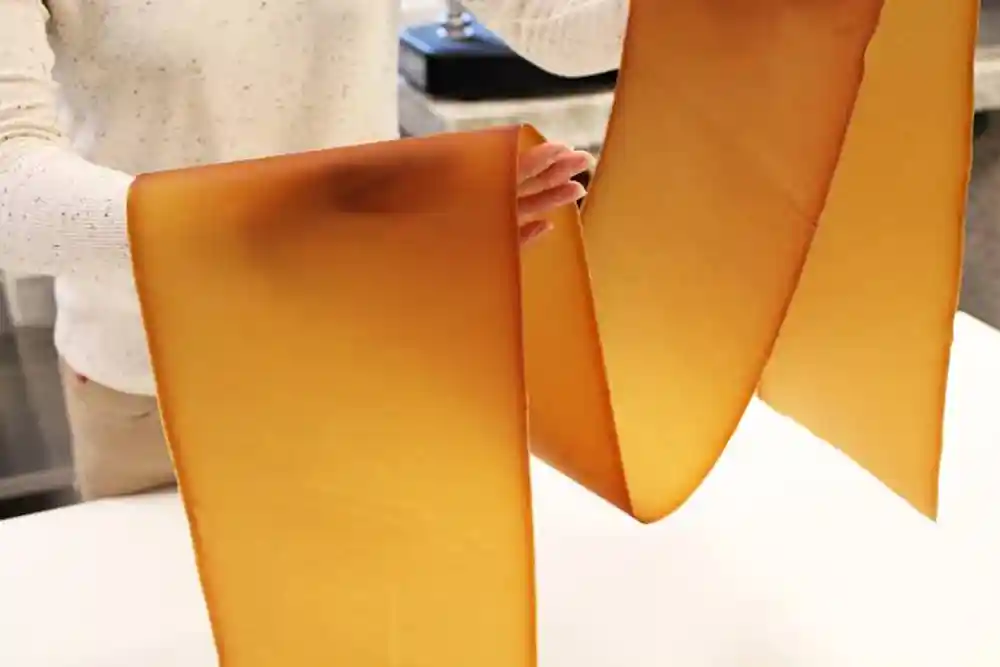
The Finnish research team has shifted fungal material production from slow tray cultivation to bioreactors and continuous sheet forming, tackling one of mycelium leather’s biggest scale-up barriers.
Researchers at Finland’s VTT Technical Research Centre have developed a scalable process for producing leather-like nonwovens from fungal mycelium, using submerged fermentation and roll-to-roll forming rather than growing individual sheets in trays. The peer-reviewed research was published in ACS Applied Bio Materials in July 2026.
From fermentation tank to fabric
The researchers cultivated Trichoderma reesei in liquid-filled bioreactors, producing a pulp-like mycelium biomass. This was formulated with sorbitol as a plasticiser and nanofibrillated cellulose as reinforcement, then formed and dried into flexible nonwoven sheets.
The approach differs fundamentally from conventional mycelium materials, which typically grow as sheets through solid-state fermentation. Because the fungal pulp can be pumped, formulated and processed continuously, it offers greater potential for industrial throughput and property control.
VTT demonstrated continuous production of sheets approximately 20 cm wide and eight metres long using roll-processing equipment and subsequently manufactured a prototype handbag.
Strength approaches leather—but flexibility lags
Optimised formulations achieved tensile strengths of 11–19 MPa, placing them within the broader range reported for bovine leather. However, elongation at break was only around 9–10%, compared with roughly 37–68% cited for chrome-tanned leather. Researchers consequently identify tear and abrasion resistance as areas requiring further development.
End-of-life advantage emerges
The material reached 77% biodegradation after 28 days in aquatic testing and completely disintegrated after about six weeks under industrial-composting conditions. By comparison, vegetable-tanned leather showed only 15% aquatic biodegradation after 119 days in the study.
The commercial significance is therefore as much about manufacturing architecture as material novelty. Bioreactors and roll-to-roll equipment are already established industrial technologies, potentially lowering the scale-up barrier.
However, VTT has not yet demonstrated commercial costs, abrasion life, repeated-flex performance or a full lifecycle assessment. Those metrics will determine whether mycelium nonwovens can progress from promising biomaterial to a credible leather substitute for footwear, accessories, automotive interiors and fashion.
The Finnish research team has shifted fungal material production from slow tray cultivation to bioreactors and continuous sheet forming, tackling one of mycelium leather’s biggest scale-up barriers.
Researchers at Finland’s VTT Technical Research Centre have developed a scalable process for producing leather-like nonwovens from fungal mycelium, using submerged fermentation and roll-to-roll forming rather than growing individual sheets in trays. The peer-reviewed research was published in ACS Applied Bio Materials in July 2026.
From fermentation tank to fabric
The researchers cultivated Trichoderma reesei in liquid-filled bioreactors, producing a pulp-like mycelium biomass. This was formulated with sorbitol as a plasticiser and nanofibrillated cellulose as reinforcement, then formed and dried into flexible nonwoven sheets.
The approach differs fundamentally from conventional mycelium materials, which typically grow as sheets through solid-state fermentation. Because the fungal pulp can be pumped, formulated and processed continuously, it offers greater potential for industrial throughput and property control.
VTT demonstrated continuous production of sheets approximately 20 cm wide and eight metres long using roll-processing equipment and subsequently manufactured a prototype handbag.
Strength approaches leather—but flexibility lags
Optimised formulations achieved tensile strengths of 11–19 MPa, placing them within the broader range reported for bovine leather. However, elongation at break was only around 9–10%, compared with roughly 37–68% cited for chrome-tanned leather. Researchers consequently identify tear and abrasion resistance as areas requiring further development.
End-of-life advantage emerges
The material reached 77% biodegradation after 28 days in aquatic testing and completely disintegrated after about six weeks under industrial-composting conditions. By comparison, vegetable-tanned leather showed only 15% aquatic biodegradation after 119 days in the study.
The commercial significance is therefore as much about manufacturing architecture as material novelty. Bioreactors and roll-to-roll equipment are already established industrial technologies, potentially lowering the scale-up barrier.
However, VTT has not yet demonstrated commercial costs, abrasion life, repeated-flex performance or a full lifecycle assessment. Those metrics will determine whether mycelium nonwovens can progress from promising biomaterial to a credible leather substitute for footwear, accessories, automotive interiors and fashion.
