

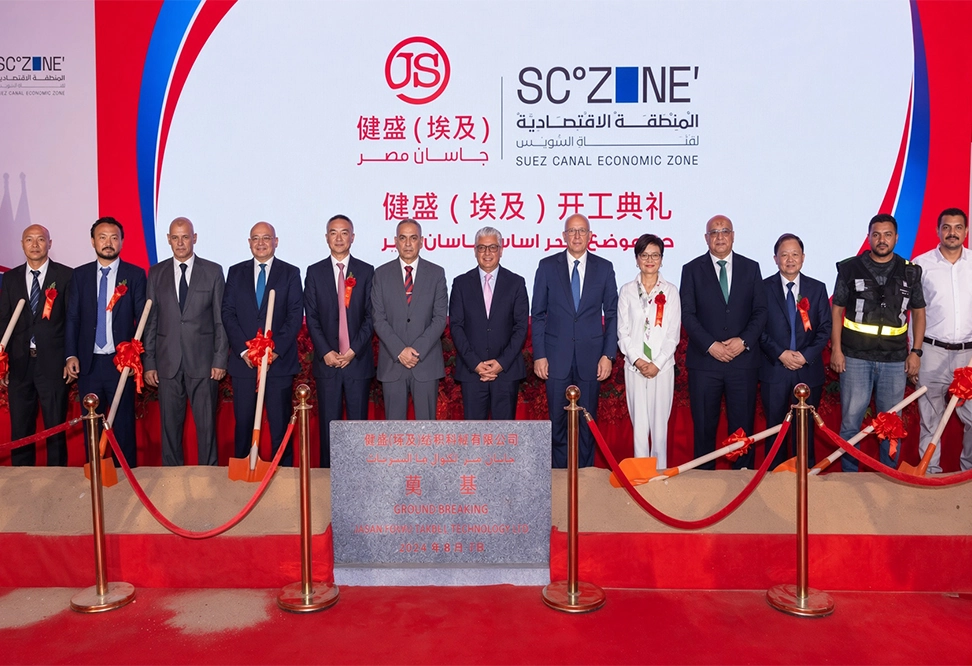
The vertically integrated, export-led complex reinforces Egypt’s emergence as a nearshore manufacturing base connecting Asian capital with European, Middle Eastern and global apparel markets.
China’s Zhejiang Jiansheng Group, commercially known as JASAN Group, has broken ground on a $117 million integrated textile and apparel complex in Egypt’s Qantara West Industrial Zone. The self-financed project will occupy 300,000 square metres and be developed in three phases.
The investment has increased from the $100 million originally announced in December 2025, signalling an expanded commitment to the Egyptian manufacturing base.
Integration moves upstream
The complex will combine spinning and weaving with ready-made garments, sportswear, seamless apparel, socks, accessories, elastic fabrics and dyeing. Around 90% of output is intended for export, with 10% serving Egypt’s domestic market. Full operation is expected to create approximately 6,000 direct jobs.
JASAN chairman Zhang Maoyi said the Egyptian operation will incorporate smart manufacturing, automation, digital management and more sustainable production technologies. The company cited Egypt’s location, trade relationships and market access as important factors behind the investment.
Qantara West becomes a textile cluster
The project joins a rapidly expanding manufacturing base at Qantara West. The zone now hosts 54 projects from nine nationalities, representing about $1.54 billion of investment and potential employment of almost 68,915 people. Textiles and ready-made garments dominate, accounting for 43 projects.
Across SCZONE, 117 industrial projects worth $7.26 billion were contracted during FY2025/26.
Egypt targets faster export growth
Egypt’s Apparel Export Council has set a 2026 garment-export target of $4.3–4.4 billion, while the broader textile and apparel industry is targeting approximately $11.5 billion annually by 2030.
For global buyers, JASAN’s investment strengthens Egypt’s proposition beyond low-cost garment assembly. The strategic opportunity is increasingly vertical integration—bringing yarn, fabric, dyeing and garment production closer together to reduce imported-input dependence and shorten supply chains.
The next measure of success will be execution: how quickly the three phases reach production, which international buyers they serve, and whether Qantara West can develop the supplier, skills and processing ecosystem needed to sustain its growing concentration of textile investment.
