

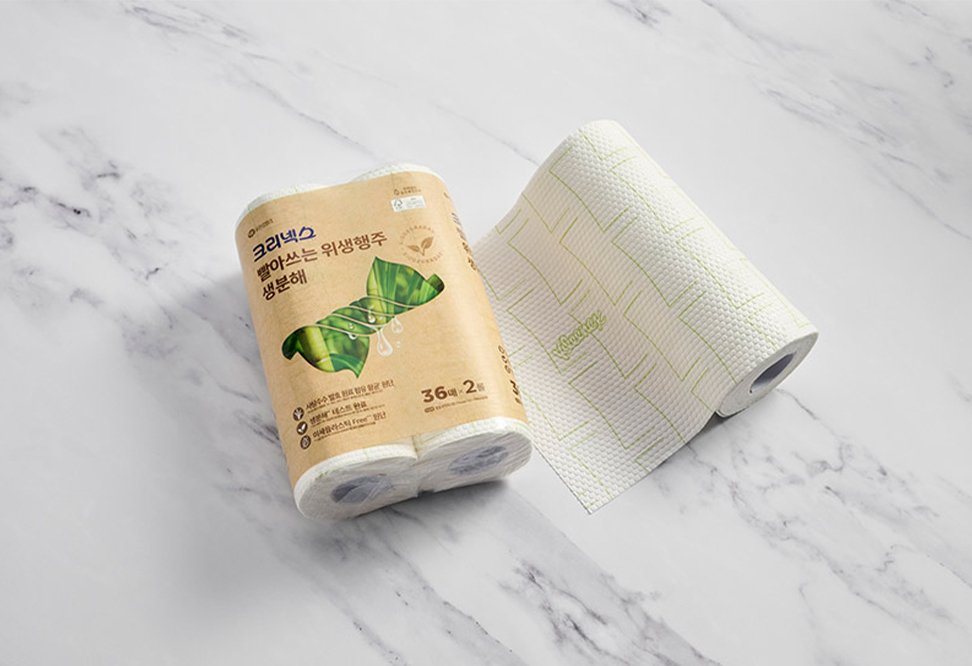
The Kleenex-branded product signals how biopolymers are moving from packaging into higher-performance nonwoven consumer applications.
CJ Biomaterials and Yuhan-Kimberly have launched what they describe as the world’s first reusable nonwoven paper towel made with amorphous PHA. The product, sold in South Korea under the Kleenex Biodegradable Reusable Dishtowel brand, uses CJ Biomaterials’ PHACT A1000P and builds on a partnership between the two companies that began in 2022.
A biobased route for nonwovens
The towel combines PHACT A1000P with plant-derived materials including cellulose and polylactic acid, or PLA, to create a 100% biobased spunbond nonwoven. Production is being handled by Eugene Hanil Synthetic Fiber, according to product reporting. The companies say the towel can be washed and reused multiple times before disposal and is already being used in homes and restaurants in South Korea.
The technical significance lies in PHA’s role as both a sustainability material and a performance modifier. CJ Biomaterials describes PHACT A1000P as a soft, rubbery, biobased amorphous PHA suitable for compounding with other polymers and for applications including fibres and nonwoven processes.
Solving a PLA performance gap
Yuhan-Kimberly had previously tested towels using PLA alone as a binder, but mechanical-performance limitations created production and product challenges. The inclusion of PHACT A1000P helped improve binding performance with cellulose fibres while allowing the company to maintain existing manufacturing processes and production speeds.
Compostability and microplastics claims
PHACT A1000P carries biodegradability and compostability certifications, including TÜV AUSTRIA OK compost Home, OK compost Industrial, OK biodegradable Marine and OK biodegradable Soil, according to CJ Biomaterials’ published technical information. The product is also positioned as avoiding persistent microplastics, a growing concern in disposable wipes, hygiene and household nonwovens.
For the nonwovens sector, the launch is commercially important because it shows a pathway beyond single-use, fossil-based binder systems. The next test will be whether PHA-based spunbond structures can scale beyond niche consumer products while remaining cost-competitive, durable in use and credible at end of life.
