

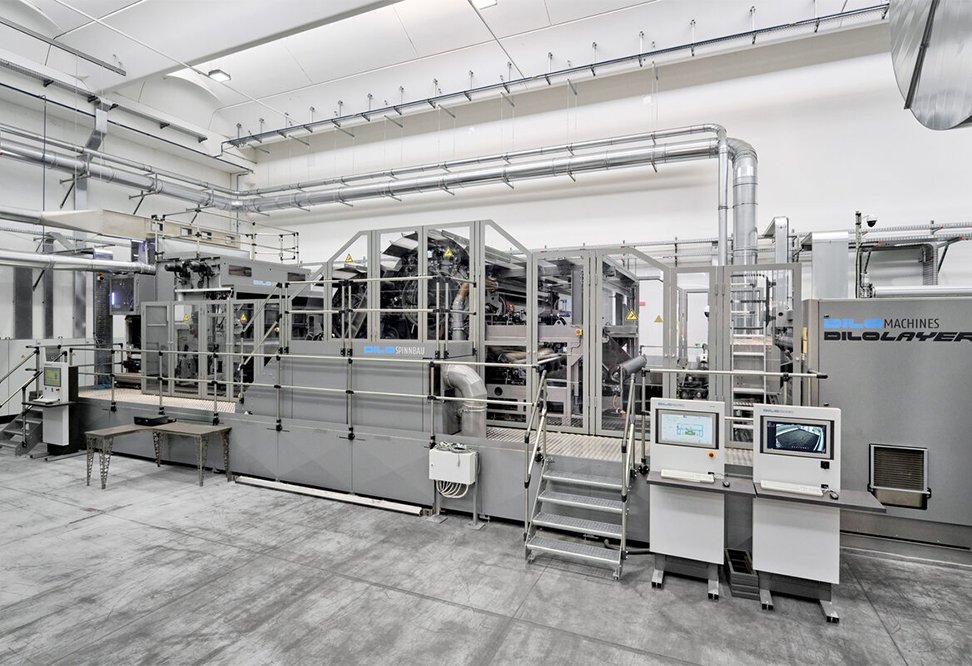
The investment underlines a key hygiene-market requirement: consistent web quality, low contamination risk and stable throughput across the full fibre-to-felt process.
DiloGroup has received an order for a complete needling line for hygiene-material production in the United States, reinforcing the importance of integrated nonwoven systems in applications where uniformity and process stability are commercially critical.
The customer, project value, line width and planned output have not been disclosed. However, the announced configuration covers the full production sequence, beginning with fibre opening and filtration and continuing through card feeding, carding, crosslapping and needling. That breadth matters because hygiene-grade nonwovens can be compromised by poor fibre preparation, inconsistent web formation, dust contamination or unstable needling conditions long before the finished roll reaches inspection.
Fibre preparation becomes a quality control point
The new installation includes a TEMAFA fibre-opening and filtration system, intended to support stable operation and manage dust and particle contamination. This is especially relevant in hygiene-related nonwoven applications, where cleanliness, fibre separation and uniform feed quality directly affect product consistency.
At the core of the line are card-feeding and carding systems from Dilo Spinnbau, followed by crosslapping and high-performance needlelooms from DiloMachines. The line will also use Dilo’s CV1 system, designed to support controlled fibre processing, stable web formation and higher throughput.
The significance is not simply that another needling line has been sold. It is that the buyer has chosen an integrated platform rather than assembling individual machines from separate suppliers. In high-volume production, that can reduce interface risk, simplify commissioning and create clearer accountability for quality, output and service performance.
Hygiene demand raises the technical bar
Needle-punched nonwovens are increasingly used where engineered bulk, resilience, absorbency, softness or controlled porosity are required. For hygiene and related personal-care materials, producers need repeatable basis weight, fibre distribution, thickness and mechanical properties, while maintaining efficient conversion economics.
That makes machinery selection a lifecycle decision. Buyers must assess not only headline capacity, but also fibre versatility, dust management, web evenness, energy intensity, maintenance access, spare-parts support and the ability to handle changing product specifications.
The next benchmark is operating evidence
DiloGroup says the installation is tailored to U.S. hygiene-market requirements and will provide a modern, efficient production set-up. Those benefits will ultimately depend on factory-floor performance: output stability, waste rates, quality consistency and the line’s ability to meet customer specifications over time.
For U.S. nonwoven producers, the signal is clear. Competitive advantage in hygiene materials increasingly depends on controlling the whole web-formation process, not merely adding needling capacity.
