

The project strengthens Italy’s role in advanced inkjet textile printing and gives Durst a deeper base in fashion and home-textile applications.
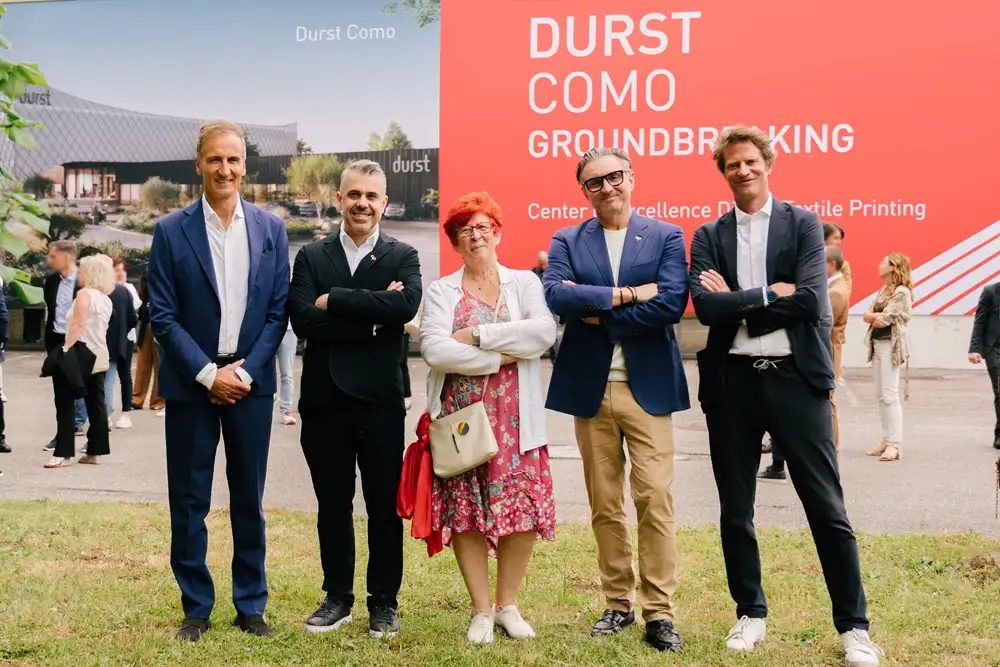
Durst Group has launched Durst Como, a new industrial and technology hub for digital textile printing in Italy’s Como textile district, backed by about €20 million in buildings and infrastructure. The Lombardy site will focus on inkjet technology, software, applied research and advanced industrial digital textile printing solutions, with particular relevance for fashion and home textiles.
From acquisition to production platform
Durst Como follows the group’s acquisition of Aleph, a specialist in advanced inkjet solutions for direct-to-fabric and paper printing. The transaction began in 2023 and was completed in 2025, after which Aleph was fully merged into Durst Group S.p.A.
The move gives Durst a stronger footprint in Como, one of Europe’s best-known textile-printing districts, while extending its existing textile base in Kufstein, Austria. Como will become Durst’s third development and production site with R&D capabilities, after Brixen/Bressanone and Lienz. Kufstein will remain focused on superwide and special developments, including drying solutions for textile and graphics applications.
A growth bet on industrial inkjet
The investment is part of a longer textile strategy. Durst says it has invested more than €50 million in its textile business over the past 12 years, including laboratory infrastructure, international market development and site expansion. The company, which reports revenues above €430 million, is targeting a doubling of revenue over the next five years, with industrial textile printing expected to support that growth.
For textile printers, the significance is practical: competition is shifting toward integrated systems combining printheads, inks, software, automation, drying and application know-how.
Sustainability built into the site
Durst says the new headquarters will be developed within an existing building, avoiding new land consumption and additional soil sealing. Planned measures include heat pumps to replace gas heating and an initial 600 kWp photovoltaic system to generate green electricity.
The next signal to watch is whether Durst Como accelerates new machine platforms, stronger customer trials and faster adoption of digital printing in premium fashion, décor and home-textile supply chains.
