

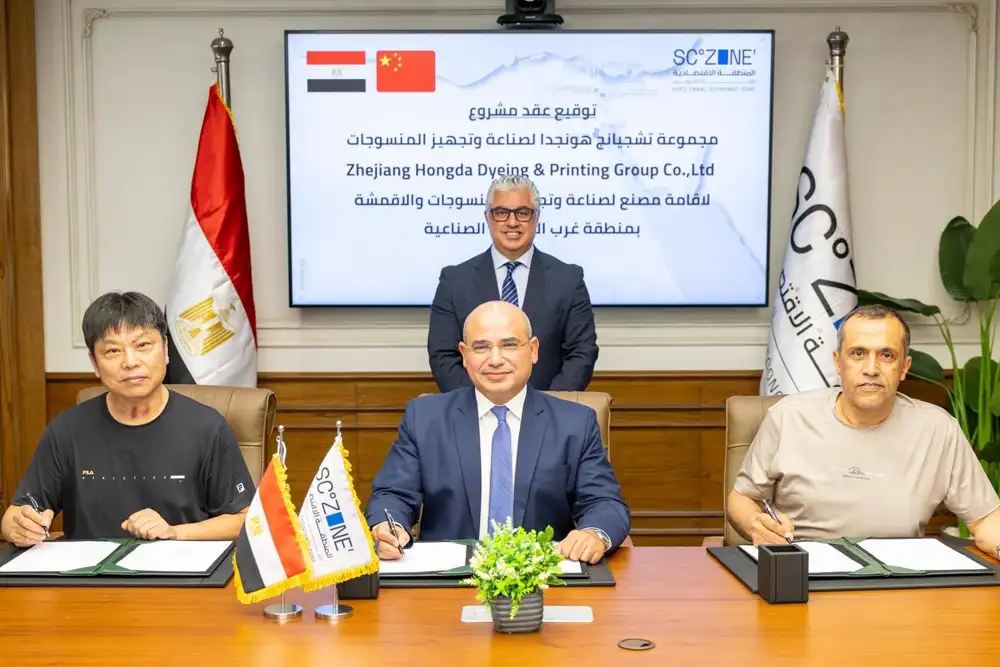
The Chinese project reinforces Egypt’s push to turn Qantara West into a concentrated export-oriented textile and garment manufacturing base.
Egypt’s Suez Canal Economic Zone (SCZone) has signed a contract with China’s Zhejiang Hongda to establish a US$20 million textile manufacturing and processing project in the Qantara West Industrial Zone. The project will cover 60,000 square metres, create around 500 direct jobs, and is expected to export 70% of its total production, according to statements from SCZone reported by Daily News Egypt.
Qantara West gathers momentum
The agreement was signed at SCZone’s headquarters in the Administrative Capital by Mostafa Shekhoun, SCZone Vice Chairman for Investment and Promotion, and company owners Maliang Lin and Abdel Malek Al-Dhabi, in the presence of SCZone Chairperson Walid Gamal El-Din.
For Egypt, the deal is another step in positioning Qantara West as a manufacturing cluster for textiles, ready-made garments, food industries and logistics. The zone now hosts 53 active industrial, service and logistics projects, with combined investment costs of US$1.48 billion, covering more than 3.42 million square metres and supporting about 69,000 direct jobs.
Export manufacturing, not simple assembly
The export ratio is commercially important. A facility designed to sell most of its output abroad can help Egypt build foreign-exchange earnings, reduce import dependence and strengthen its role as a regional supply base. SCZone has framed such projects as part of its localisation strategy, arguing that targeted industrial investments can reduce the import bill while serving domestic and neighbouring markets.
The project also fits a broader pattern: Asian textile investors are using Egypt’s industrial zones to reach Europe, Africa and the Middle East with shorter logistics routes than many Asian production bases.
Infrastructure will decide competitiveness
The next issue is execution. Qantara West’s success will depend on timely utilities, transport links, customs efficiency, skilled labour and the ability to connect textile processing with garmenting, trims, testing and compliance services.
For regional competitors, including Pakistan, Bangladesh and Türkiye, the signal is clear: Egypt is not only attracting factories; it is building clustered textile capacity around trade access and logistics. That makes Qantara West a sourcing location to watch closely.
