

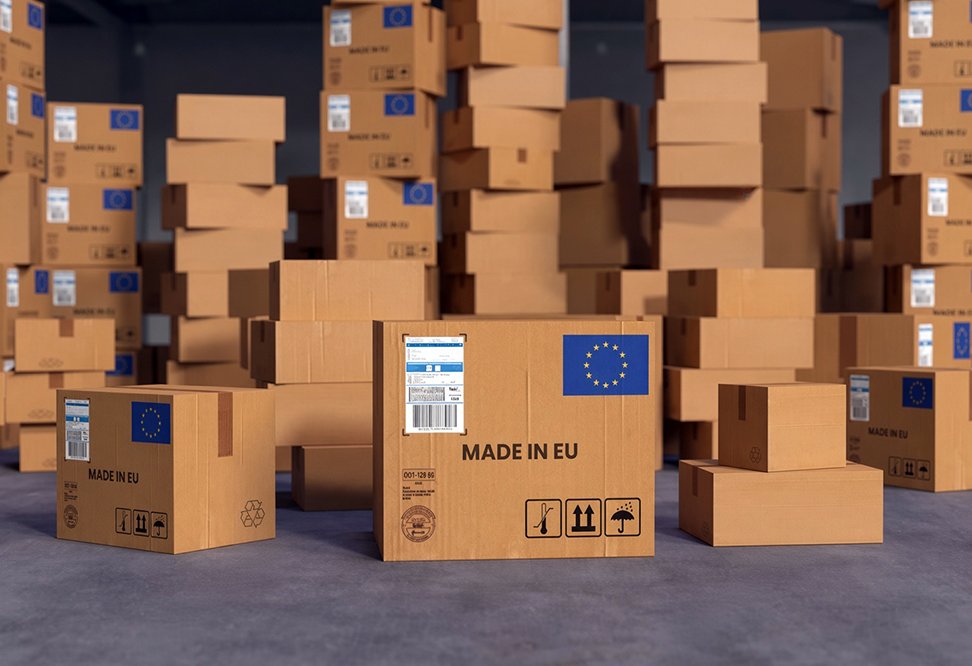
The PPWR now applies across the EU, bringing new manufacturer, documentation and registration obligations for everything from cartons and polybags to hangtags and clothes hangers.
The EU’s Packaging and Packaging Waste Regulation entered into application on August 12, 2026, extending a broad set of sustainability, conformity and information requirements to packaging used throughout textile and apparel supply chains. German industry association Südwesttextil warns that the rules could create disproportionate bureaucracy and legal uncertainty, particularly for smaller companies.
Branding can change who is liable
A central challenge is identifying the legal “manufacturer” of packaging. Under the PPWR, companies that have packaging designed or produced under their own name or trademark can inherit manufacturer obligations even when a third party physically produces it. Manufacturers must conduct conformity assessments, prepare technical documentation and issue EU declarations of conformity.
Packaging must also carry a type, batch, serial number or equivalent identifier, while manufacturer contact information must appear on the packaging, through an approved data carrier or in accompanying documentation. Single-use packaging records generally need to be retained for five years; reusable packaging documentation for ten.
Textile packaging reaches beyond cartons
Südwesttextil says the compliance burden can extend to hangtags, clothes hangers, pins, films, insert papers, shipping cartons and carrier bags. The association particularly disputes treating purely informational labels and frequently reused clothes hangers as packaging subject to waste-system obligations. These are industry advocacy positions rather than exemptions currently established in the regulation.
Harmonised material-composition and sorting labels are scheduled from August 2028 or later, depending on implementing legislation. From 2030, further provisions include recyclability and recycled-content requirements and a maximum 50% empty-space ratio for grouped, transport and e-commerce packaging.
Packaging data becomes another compliance layer
For textile brands and exporters, the practical requirement is to map every packaging component, identify the responsible economic operator and obtain material, weight, supplier and conformity data.
The larger problem is regulatory fragmentation. Although PPWR creates EU-wide product requirements, producer registration and extended-producer-responsibility implementation remain linked to individual member states. For companies already preparing textile DPP, EPR and ecodesign data, packaging is becoming another product-level dataset that must be controlled alongside the garment itself.
