

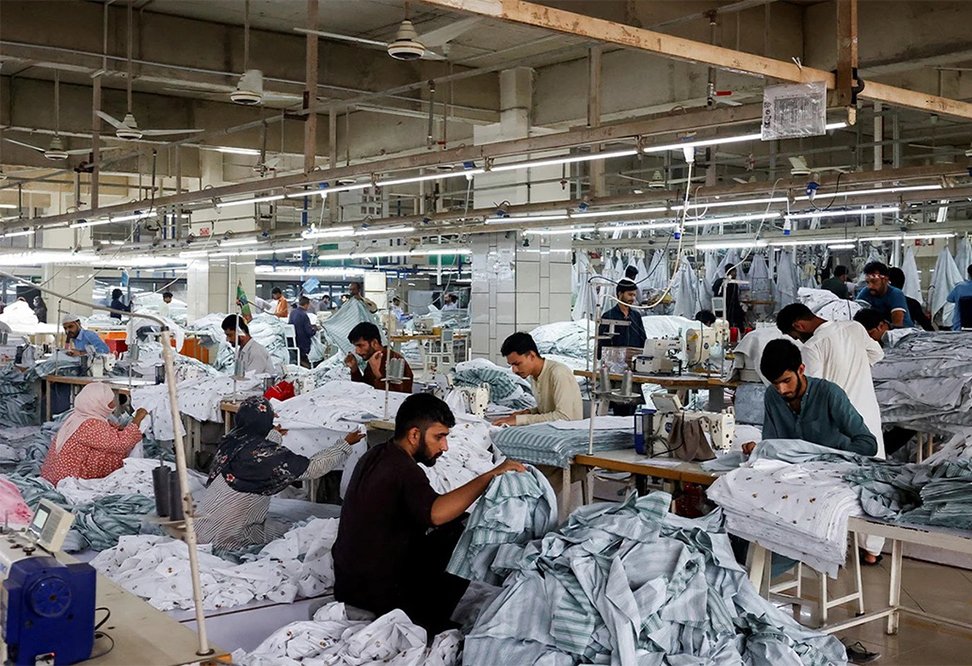
Pakistan’s textile sector is showing early signs of stabilisation, but growth is concentrated downstream while cotton, energy costs and weak upstream manufacturing continue to constrain competitiveness.
Pakistan’s textile and clothing exports rose 5.55% year on year to $3.38 billion in July–August FY2026/27, strengthening hopes that the country’s largest export industry is emerging from several years of stagnation. Readymade garments led the improvement, rising 13.59% to $827 million, while knitwear increased 4.79%, towels 6.74% and cotton yarn 34.8%.
The improvement follows an essentially flat FY2025/26, when textile exports edged up only 0.26% to $17.93 billion.
Downstream manufacturing pulls ahead
Production data reveal a pronounced split within the value chain. Pakistan’s overall large-scale manufacturing expanded 4.98% in FY2025/26, but textile manufacturing contracted 0.63%, while wearing apparel grew 5.49%.
That divergence widened in July 2026: apparel production jumped 22.03%, whereas the broader textile group declined 3.09%. Cotton yarn output increased 2.73%, while cotton cloth slipped 0.09%.
The figures suggest Pakistan is currently finding greater momentum in value-added garment conversion than in its traditional upstream textile base.
Cotton offers cautious relief
Cotton arrivals reached 2.389 million bales by September 15, up 19.17% year on year. Punjab arrivals increased 24.73% and Sindh 16.25%. However, the latest fortnightly increase was only 3.5% above last year, while pink bollworm, rainfall and fibre-quality risks remain.
Domestic production therefore remains far below historical levels, keeping spinning mills exposed to imported cotton, freight and exchange-rate movements.
Competitiveness, not recovery, is the real test
Pakistan’s draft Textile and Apparel Policy targets $29.381 billion of exports by FY2029/30, requiring growth of roughly 64% from FY2025/26 levels.
Achieving that scale will require more than cyclical recovery. The priorities are competitive energy costs, machinery modernisation, MMF diversification, productivity, technical textiles and higher-value apparel. The strongest current signal is positive: value-added garments are outperforming the upstream chain. The risk is that Pakistan’s underlying cost and raw-material weaknesses prevent that momentum from becoming a durable industrial revival.
