

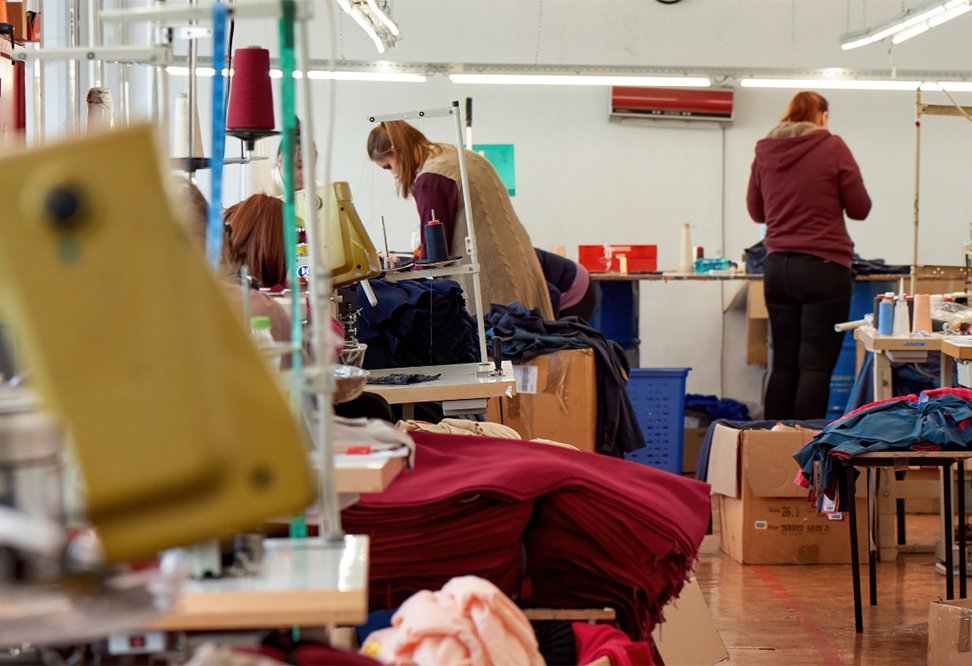
Swedish machinery specialist Svegea shows how automating small garment-preparation processes such as bias binding can improve repeatability, reduce waste and protect finished-product quality.
The apparent simplicity of a well-made dress can conceal substantial manufacturing precision. Sweden’s Svegea, a member of the Swedish Textile Machinery Association (TMAS), is highlighting automated equipment for producing bias binding—the flexible fabric strips used around necklines, armholes and other curved garment edges.
Bias strips are cut diagonally to the fabric grain, giving them enough flexibility to follow curves without puckering or distortion. At industrial scale, however, maintaining constant width, angle and tension across thousands of garments becomes a production-control problem rather than a sewing-room task.
Three stages replace manual preparation
Svegea’s system starts with its Tube Sewing Unit 200A, which automatically folds and sews open-width fabric into a continuous tube. It incorporates photocell edge alignment, thread-break detection, speed control and automatic trimming, and can process material up to 2,000 mm wide.
The Bias Cutter/Winder 200 then opens the tube spirally at the required bias angle and rewinds it into a single-ply roll ready for slitting. The machine operates at speeds of up to 30 metres per minute, with standard bias angles of 38–52 degrees.
Final slitting can produce strips as narrow as 6 mm, while wider widths can be prepared for heavier garments and structural applications.
Small process, larger productivity lesson
The technology applies well beyond dresses. Bias binding is widely used in blouses, childrenswear, activewear, bags and home textiles, while Svegea also supplies collarette cutters and roll-slitting systems.
For garment manufacturers, the broader significance is the automation of processes that remain dependent on operator skill. Small variations in cutting or preparation can generate sewing problems, rework, inconsistent fit and material loss later in production.
Competitiveness takeaway
For Pakistan’s apparel industry, productivity improvement does not require automation only in cutting rooms or sewing lines. Significant gains can also come from mechanising fabric preparation, binding, trimming, feeding and handling operations.
As exporters move toward higher-value fashion, sportswear and smaller-order production, technologies that deliver repeatability, faster changeovers and lower dependence on manual skill can become increasingly important. The competitive question is therefore not simply labour cost, but how much consistent output each production worker and machine hour can deliver.
