


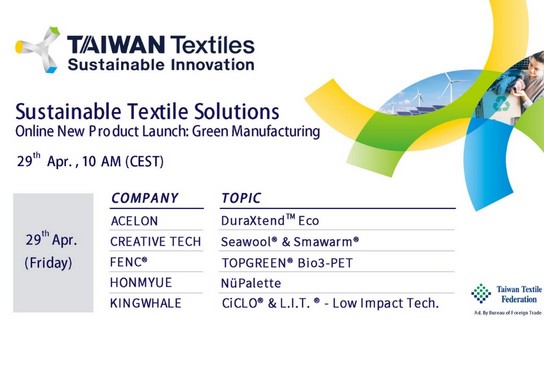
Over the years, Taiwan has become the top choice of many international leading brands in going green. To assist Taiwan’s textile industry in further its’ efforts to expand its green products to the global market, with the support of the Bureau of Foreign Trade, the Taiwan Textile Federation (TTF) has planned a three-episode online new product launch program that is set to release in March, April, and May.
This month, TTF will be focusing on green manufacturing. In May, TTF will walk you through the latest concepts of circular fashion developed by leading textile manufacturers and how it transforms consumers’ purchase and consumption habits. The online streaming event will be held via TTF’s Textile Export Promotion Project official Facebook and YouTube on Apr. 29th at 10 AM CEST, do not miss this valuable opportunity to be the first one to see the revolutionary changes in the textile industry!
According to figures from the United Nations Environment Programme (UNEP), every year, the fashion industry uses 93 billion cubic meters of water to meet five million people’s consumption needs.
The apparel industry makes up an important part of the global economy; however, it also damages the environment excessively. Apparel production makes up 10% of the carbon emissions. At this pace, the fashion industry’s greenhouse gas emissions will surge by more than 50 % by 2030! As the textile industry faces increasing global pressure to make changes, it is worth noting that Taiwan’s textile industry has strong knowledge and expertise on material innovations that design and create sustainable fabrics using natural and recyclable materials with eco-friendly energy.
To cope with the impact of climate change, governments, society, and enterprises around the world are all moving towards the goal of global net-zero emissions. Both the global textile industry and Taiwan face the challenge of climate change.
With the improvement of chip manufacturing technology, water, electricity, and resources consumption are also increasing. ESG and sustainable development have become the key competitiveness of Taiwan’s textile industry chain resilience in the next decade.

