


Page 60 - April-May-2020
P. 60
60            E-textile developed with 3D                                                                                       New Karl Mayer raschel machine for                                                             77


         Whats New  printer depositing conductive                                                                                  KARL MAYER launches new raschel machine for nonwoven                                                  Whats New
                                                                                                                                                             nonwoven bonding


                                    fibers onto fabric
                                                                                                                                   bonding. The new raschel machine for nonwoven bonding,
                                                                                                                                   RACOP 2-NW, will be presented at Techtextil. This efficient
                                                                                                                                   nonwoven machine processes fibrous webs to
                                                                                                                                   stitch-bonded nonwovens, and scores points by
                                                                                                                                   technological advantages. Unlike their chemically bonded
                                                                                                                                   counterparts, these nonwovens are elastic, voluminous
                                                                                                                                   and, thus, virtually textile.
                                                                                                                                   Moreover, the stitch-bonding process requires considerably
                                                                                                                                   less energy than thermal methods. In addition, the RACOP
                                                                                                                                   2-NW impresses by an excellent price-performance ratio
                                                                                                                                   and highest flexibility. During KARL MAYER’s in-house
                                                                                                                                   show, a RACOP 2-NW will produce a fabric in a gauge of E
                                                                                                                                   14 intended for the application field of heating textiles. The
                                                                                                                                   heating effect can be tested on a demonstrator module.


                                                                                                                                      ESMETEX, generating an online


                                                                                                                                                fabric sourcing platform


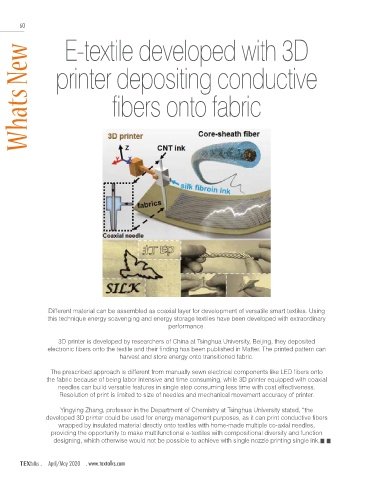
                Different material can be assembled as coaxial layer for development of versatile smart textiles. Using
                this technique energy scavenging and energy storage textiles have been developed with extraordinary
                                                      performance.                                                                  Taiwan based company Esmetex for fabric sourcing and production, is currently launching a platform with world’s
                                                                                                                                   largest online fabric database. This platform is digitizing the fabric supply chain from development to inspection then
                   3D printer is developed by researchers of China at Tsinghua University, Beijing, they deposited                    3-D garment design. It contains over 18,000 fabrics from Esmetex’s own mill and outside 25 mills under their
                electronic fibers onto the textile and their finding has been published in Matter. The printed pattern can         management- with approximately 1000 items adding/month. The company has planned to work with leading brands
                                       harvest and store energy onto transitioned fabric.                                           and national retailors to add more articles from their partners to develop an integrated system where all customer’s
                                                                                                                                                           vendor fabric details are available digitally on single click.
                 The prescribed approach is different from manually sewn electrical components like LED fibers onto
                the fabric because of being labor intensive and time consuming, while 3D printer equipped with coaxial              Esmetex claimed that the Frontier digital platform can cut the creative development cycle by more than two weeks,
                   needles can build versatile features in single step consuming less time with cost effectiveness.                by brilliantly gathering and organizing information from the supply chain as per requirement. Environmental aspects
                    Resolution of print is limited to size of needles and mechanical movement accuracy of printer.                 of platform are also highlighted by Esmetex. All the fabric are available digitally with every detail, therefore, instead of
                                                                                                                                   manufacturing new fabric the already existing can be used, reducing the hazardous effects of finishes and dyestuffs,
                    Yingying Zhang, professor in the Department of Chemistry at Tsinghua University stated, “the                                          saving the resources and increasing the cost effectiveness.
               developed 3D printer could be used for energy management purposes, as it can print conductive fibers
                   wrapped by insulated material directly onto textiles with home-made multiple co-axial needles,                  Brands and retailers can access the quality of fabric due to frontier inspection app. Due to available online QC report
                 providing the opportunity to make multifunctional e-textiles with compositional diversity and function             for every fabric. Moreover, defects can be assessed and managed during garment cutting reducing the wastage.
                  designing, which otherwise would not be possible to achieve with single nozzle printing single ink.


                April/May 2020                                                                                                                                                                                 April/May 2019

