


Page 52 - February-March-2017
P. 52
52
 leading solution supplier in the area of plastic recycling
 systems and technologies. Both companies joined their
 efforts to develop a one-step system for pre-processing                                                                          LABORATORY SOLUTIONS
 and spinning polyester flakes into Bulk Continuous
                                                                                                                                  BUILT TO MAP
 Filament (BCF) for carpet applications.

 The new system directly links EREMA’s VACUREMA®
 technology with Trützschler Switzerland’s symTTex BCF
 machinery (figure 2). The EREMA part consists of a
 vacuum reactor, a directly linked single-screw extruder
 and a high-performance filter. Washed R-PET flakes are
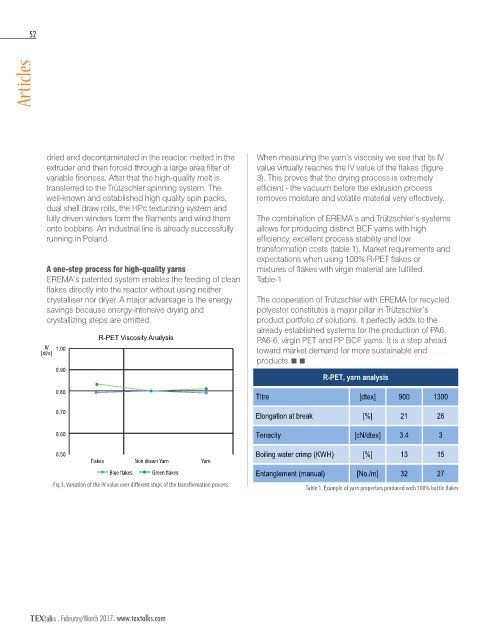
            dried and decontaminated in the reactor, melted in the   When measuring the yarn’s viscosity we see that its IV
            extruder and then forced through a large area filter of   value virtually reaches the IV value of the flakes (figure
            variable fineness. After that the high-quality melt is   3). This proves that the drying process is extremely
            transferred to the Trützschler spinning system. The   efficient - the vacuum before the extrusion process
            well-known and established high quality spin packs,   removes moisture and volatile material very effectively.
            dual shell draw rolls, the HPc texturizing system and
            fully driven winders form the filaments and wind them   The combination of EREMA’s and Trützschler’s systems
            onto bobbins. An industrial line is already successfully   allows for producing distinct BCF yarns with high
            running in Poland.                                efficiency, excellent process stability and low
                                                              transformation costs (table 1). Market requirements and
                                                              expectations when using 100% R-PET flakes or
            A one-step process for high-quality yarns         mixtures of flakes with virgin material are fulfilled.
            EREMA’s patented system enables the feeding of clean   Table-1
 All of us use plastic bottles almost every day.   the collection of the bottles and pressing them into   flakes directly into the reactor without using neither
 Especially life without bottled water is not conceivable   bales. Afterwards, the bales are opened, sorted out   crystalliser nor dryer. A major advantage is the energy   The cooperation of Trützschler with EREMA for recycled
 in developing and developed countries. Whereas   and grinded. The flakes obtained are washed (cold   savings because energy-intensive drying and   polyester constitutes a major pillar in Trützschler’s
 glass was the main material for bottles in the last   and hot) and separated from the polyolefin, which   crystallizing steps are omitted.  product portfolio of solutions. It perfectly adds to the
 century, producers and consumers more and more   comes from caps and gaskets. After drying and metal   already established systems for the production of PA6,
 favoured PET – polyethylenterephthalate - since the   separation, the flakes are practically ready to be filled   R-PET Viscosity Analysis  PA6-6, virgin PET and PP BCF yarns. It is a step ahead
 late 1980s. These “polyester” bottles come with the   into silos or big bags. A new cycle begins.  IV  1.00  toward market demand for more sustainable end
 distinctive advantages of being light weight and   [dl/e]    products.
 almost unbreakable.   One of the main processes for recycled polyester is   Spinning BCF yarn from PET and R-PET  0.90
 spinning staple fibers, which can be used for spun                          R-PET, yarn analysis
 However, the success generates the new challenge of   yarns, textile fillings or nonwoven materials for   PET fibers offers numerous advantages in carpet   0.80
 applications. Especially the high stain resistance should
 coping with billions of discarded bottles each year.   instance. These applications are well established with   be mentioned, which is even higher than that of    Titre  [dtex]  900  1300
 When the bottle is empty we often throw it away, even   fleece shirts and throws being prominent examples.   chemically treated PA BCF. Moreover, PET can be spun   0.70
 though some of us would keep it for a second life. In   in undyed form, which is not the case for PP. Undyed    Elongation at break  [%]  21  26
 many regions of the world recycling is an option. In   Besides, due to many factors, the collection and   yarns can be twisted, heat set, dyed and tufted or the   0.60   Tenacity  [cN/dtex]  3.4  3
 Asia, for example, the probability that an empty bottle   recycling rate of plastic bottles is growing worldwide.   finished carpet can be printed.
 will be recycled is more than 75%. However,   Therefore it is time to explore new end uses of the   0.50   Boiling water crimp (KWH)  [%]  13  15
 unfortunately there are also regions with recycling   recycled PET like carpet application for example   Compared to staple fiber production, using R-PET for   Flakes  Non drawn Yarn  Yarn
 rates not exceeding 15%.  (figure 1).                                                                                                                                                                      SEE WHAT’S NEXT
 manufacturing continuous filaments is much more   Blue flakes  Green flakes   Entanglement (manual)  [No./m]  32  27
 challenging. In filament spinning the quality of the yarn   Fig 3. Variation of the IV value over di erent steps of the transformation process                                                             www.loepfe.com
 Recycling in Asia is widespread because especially   is determined by the homogeneity of the raw material.   Table 1. Example of yarn properties produced with 100% bottle  akes
 entrepreneurs in China early recognized PET bottles   Recycled flakes are an instability factor, small deviations
 as a valuable raw material. Using recycled polyester   in quality can lead to an increased number of filament
 flakes offers numerous advantages: the economical   breaks or broken filaments. Further, the variance in the
 aspect (flakes are cheaper than virgin chips) and the   flakes quality could affect the yarn’s colour pick-up so
 sustainability/good image aspect (green label) are to   the finished carpet shows streaks.
 be mentioned among them.
 The EREMA-Trützschler system
 Recycling PET bottles  This challenge is the reason that Trützschler and
 A long and complex process chain is needed to turn a   EREMA started to collaborate. EREMA Engineering
 used bottle into usable raw material. It all starts with
 Recycling Maschinen und Anlagen Ges.m.b.H. is a

