


Page 46 - TEXtalks International June/July-2025
P. 46
46 47
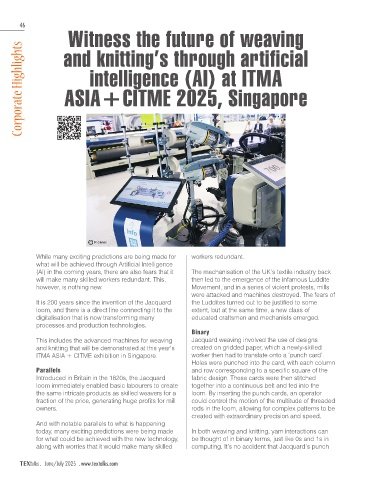
Witness the future of weaving cards inspired Charles Babbage to use similar
devices in his Analytical Engine, one of the first
and knitting’s through artificial mechanical computers.
intelligence (AI) at ITMA IoT connectivity
Fast forward 200 years, and industrial weaving and
knitting machines are reaching the next level of
ASIA+CITME 2025, Singapore performance through the integration of digital
technologies.
Computerised control systems and IoT (Internet of
Things) connectivity have become standard features
in modern machines, allowing for real-time
monitoring, predictive maintenance, and remote comparable to or faster than air-jet weaving when
diagnostics. These significantly reduce downtime measured by fabric output per minute. The leading
and optimise performance, while digital control is technology provider of high-speed tricot and raschel
also enabling greater design flexibility and rapid machines here is Karl Mayer (Germany). The
changes in patterns and structures without company’s HKS 3-M tricot machine operates at
mechanical adjustments. speeds of up to 4,000 rpm and 3,000 stitches per
minute per guide bar.
Automation is also dramatically changing how
industrial knitting and weaving systems operate, Air jet looms meanwhile now operate at up to 2,000
from automated yarn feeding and tension control to ppm (picks per minute), depending on fabric and
robotic arms handling fabric rolls and maintenance yarn type, with typical working speeds for lightweight
tasks. Advanced tension control and auto-correction to medium fabrics such as shirting, sheeting, and
systems now ensure defect-free fabrics with minimal denim, of between 1,200–1,800 ppm. The leading
intervention. air-jet machines include the JAT810 from Toyota
(Japan) the ZAX-e Series of Tsudakoma (Japan), the
In weaving, automatic warp-tying and shedding A900 Series of Itema (Italy), and the OmniPlus-i
While many exciting predictions are being made for workers redundant. mechanisms have evolved, increasing changeover Connect of Picanol (Belgium).
what will be achieved through Artificial Intelligence speed and operational reliability, and similarly,
(AI) in the coming years, there are also fears that it The mechanisation of the UK’s textile industry back knitting machines now often feature automatic Adaptability
will make many skilled workers redundant. This, then led to the emergence of the infamous Luddite needle selection and advanced loop formation What will also be very evident at ITMA ASIA +
however, is nothing new. Movement, and in a series of violent protests, mills control for precision at high speeds. CITME, Singapore in October 2025, is that all
were attacked and machines destroyed. The fears of machines are now increasingly being designed to
It is 200 years since the invention of the Jacquard the Luddites turned out to be justified to some Machine speeds minimise waste and energy consumption through
loom, and there is a direct line connecting it to the extent, but at the same time, a new class of Speed has always been a priority, and knitting developments in lubrication systems and
digitalisation that is now transforming many educated craftsmen and mechanists emerged. machines have reached new levels of productivity, energy-efficient motors.
processes and production technologies. with finer gauge capabilities allowing for intricate
Binary and lightweight fabrics. The demand for fast fashion and bespoke technical
This includes the advanced machines for weaving Jacquard weaving involved the use of designs textiles has also encouraged manufacturers to
and knitting that will be demonstrated at this year’s created on gridded paper, which a newly-skilled The circular knitting machines developed by leading create more agile and adaptable machinery. Digital
ITMA ASIA + CITME exhibition in Singapore. worker then had to translate onto a ‘punch card’. brands such as Mayer & Cie (Germany), Pailung jacquard weaving and electronic patterning in
Holes were punched into the card, with each column (Taiwan) and Santoni (Italy) now operate at speeds knitting allow for mass customisation with minimal
Parallels and row corresponding to a specific square of the of between 60-80 rpm with an output of over 30 setup time.
Introduced in Britain in the 1820s, the Jacquard fabric design. These cards were then stitched metres per hour, depending on gauge and
loom immediately enabled basic labourers to create together into a continuous belt and fed into the fabric type. Smaller batch sizes, rapid prototyping, and quicker
the same intricate products as skilled weavers for a loom. By inserting the punch cards, an operator market responsiveness are now possible thanks to
fraction of the price, generating huge profits for mill could control the motion of the multitude of threaded Flatbed knitting machines for 3D knitting, seamless enhanced software interfaces and modular
owners. rods in the loom, allowing for complex patterns to be garments, and shaped components have been machinery configurations.
created with extraordinary precision and speed. pioneered by Shima Seiki (Japan) with carriage
And with notable parallels to what is happening speeds of up to 1.6 metres per second, which Since the 1820s, there has been no stopping the
today, many exciting predictions were being made In both weaving and knitting, yarn interactions can translates to high stitch rates depending on the gauge. forward motion of the textile machinery industry,
for what could be achieved with the new technology, be thought of in binary terms, just like 0s and 1s in Warp knitting is the fastest form of knitting and driven from the very start by digitalisation.
along with worries that it would make many skilled computing. It’s no accident that Jacquard’s punch
June/July 2025 June/July 2025

