


Page 78 - TEXtalks International June/July-2025
P. 78
78                                                                                                                                                                                                                              79

                                                            Circular building                                                                   Solar fabric emerges as a


                                                            solutions using                                                           flexible energy-generating textile


                                                            flax-based                                                                Solar fabric, also known as photovoltaic textile, is an innovative material that integrates photovoltaic cells


                                                            composites                                                             organic photovoltaic cells that are lightweight, bendable, and often less efficient but significantly more versatile.
                                                                                                                                     directly into yarns, threads, or coatings on fabric. This fabric harnesses sunlight to generate electricity while
                                                                                                                                     retaining textile flexibility and adaptability. Unlike traditional rigid silicon panels, solar fabrics use thin-film or

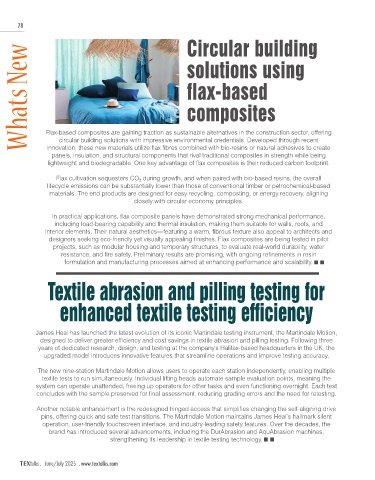
               Flax-based composites are gaining traction as sustainable alternatives in the construction sector, offering            Researchers have developed various approaches, including embedding small cylindrical PV cells around
                    circular building solutions with impressive environmental credentials. Developed through recent                    individual fibers and applying printable solar skins onto lightweight substrates. Breakthroughs include
                innovation, these new materials utilize flax fibres combined with bio-resins or natural adhesives to create         semiconducting nanomaterial inks and perovskite-based films. For example, MIT researchers have fabricated
                 panels, insulation, and structural components that rival traditional composites in strength while being             ultralight solar fabric capable of generating around 370 W per kilogram, and Australian teams have created
                lightweight and biodegradable. One key advantage of flax composites is their reduced carbon footprint.                                      flexible solar skins achieving 16.6 percent efficiency.

                   Flax cultivation sequesters CO  during growth, and when paired with bio-based resins, the overall                These fabrics can withstand daily wear, being rolled and unrolled hundreds of times while preserving over 90
                lifecycle emissions can be substantially lower than those of conventional timber or petrochemical-based              percent of their power-generating capacity. Applications for solar fabric span wearable technology, such as
                 materials. The end products are designed for easy recycling, composting, or energy recovery, aligning               jackets, backpacks, and fitness gear that charge personal devices—to architectural elements like awnings,
                                           closely with circular economy principles.                                                shade sails, and building facades. They are also suited to mobile and off-grid environments, including tents,
                                                                                                                                    marine sails, and refugee shelters. Due to their lightweight, aesthetic integration, and portability, solar textiles
                 In practical applications, flax composite panels have demonstrated strong mechanical performance,                                   are particularly valuable in sectors where rigid panels are impractical.
                  including load-bearing capability and thermal insulation, making them suitable for walls, roofs, and
               interior elements. Their natural aesthetics—featuring a warm, fibrous texture also appeal to architects and
                designers seeking eco-friendly yet visually appealing finishes. Flax composites are being tested in pilot
                  projects, such as modular housing and temporary structures, to evaluate real-world durability, water
                    resistance, and fire safety. Preliminary results are promising, with ongoing refinements in resin
                     formulation and manufacturing processes aimed at enhancing performance and scalability.                     Exploring biological and

                Textile abrasion and pilling testing for                                                                          bacterial approaches in


                    enhanced textile testing efficiency                                                                             construction materials


            James Heal has launched the latest evolution of its iconic Martindale testing instrument, the Martindale Motion,       The rising cost of repairs due to material degradation   remain dormant within the material for over two
              designed to deliver greater efficiency and cost savings in textile abrasion and pilling testing. Following three     and corrosion has inspired interest in self-healing   centuries. When cracks form and water infiltrates,
             years of dedicated research, design, and testing at the company's Halifax-based headquarters in the UK, the           construction materials, with concrete as a key focus.   these microbes activate, consuming calcium lactate
               upgraded model introduces innovative features that streamline operations and improve testing accuracy.              Microcracks and freeze–thaw damage can           and depositing limestone to seal fissures.
                                                                                                                                   significantly impact infrastructure durability, costing
             The new nine-station Martindale Motion allows users to operate each station independently, enabling multiple          industrialised nations about 3% of GDP each year. A   This process simultaneously helps protect
              textile tests to run simultaneously. Individual lifting heads automate sample evaluation points, meaning the         new report from IDTechEx spotlights emerging     embedded steel reinforcement by depleting oxygen,
            system can operate unattended, freeing up operators for other tasks and even functioning overnight. Each test          technologies that prevent such deterioration by   slowing corrosion. Another intriguing method involves
             concludes with the sample preserved for final assessment, reducing grading errors and the need for retesting.         actively repairing damage before it worsens.     coating concrete with bacteria-containing fibres.
                                                                                                                                                                                    These fibres act like built-in stitches that limit crack
             Another notable enhancement is the redesigned hinged access that simplifies changing the self-aligning drive          Among the most promising are biological methods,   propagation and support targeted self-healing. Such
              pins, offering quick and safe test transitions. The Martindale Motion maintains James Heal’s hallmark silent         especially those using bacteria-coated fibres and   approaches foster scalable applications across
              operation, user-friendly touchscreen interface, and industry-leading safety features. Over the decades, the          bacteria-infused concrete. Companies like Basilisk   high-volume construction scenarios, such as slabs
                brand has introduced several advancements, including the DurAbrasion and AquAbrasion machines,                     have developed mineral-producing bacteria that can   and walls.
                                    strengthening its leadership in textile testing technology.


               June/July 2025                                                                                                                                                                                    June/July 2025

