


Page 76 - TEXtalks International June/July-2025
P. 76
76                                                                                                                                                                                                                             77


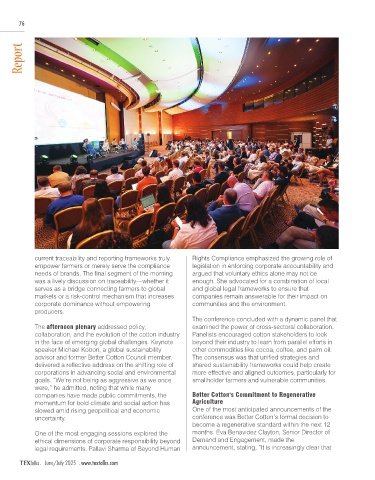
 The Better Cotton Conference 2025 convened over   farming communities. The session explored the
 two dynamic days, June 18 and 19, at the Swissôtel   persistent inequalities faced by farmers, especially
 Büyük Efes in İzmir, Türkiye, bringing over 370   women, and called on stakeholders to accelerate
 participants from 24 countries, uniting farmers,   the adoption of fairer practices. In a stirring keynote,   The afternoon plenary moved the conversation   emphasized that peer-to-peer influence and visible   current traceability and reporting frameworks truly   Rights Compliance emphasized the growing role of
 policymakers, sustainability experts, and industry   Lavinia Muth spotlighted the glaring gender   toward environmental restoration and how the cotton   success stories are accelerating the adoption of   empower farmers or merely serve the compliance   legislation in enforcing corporate accountability and
 stakeholders in a dynamic and forward-looking   disparities in the cotton sector. “Women produce   industry can turn climate commitments into tangible,   regenerative techniques in his region.  needs of brands. The final segment of the morning   argued that voluntary ethics alone may not be
 dialogue. With the theme “It Starts with Farmers,”   60–80% of global cotton but own less than 10% of   measurable actions. Climate activist Tori Tsui   was a lively discussion on traceability—whether it   enough. She advocated for a combination of local
 the two-day event focused on building a fairer, more   the land,” she said, drawing attention to the   delivered a compelling keynote connecting the use of   Deepening Impact Through Data and Shaping Policy   serves as a bridge connecting farmers to global   and global legal frameworks to ensure that
 sustainable cotton sector by recognizing and   entrenched challenges that continue to limit   fossil fuels in fashion to the broader climate crisis,   for the Future  markets or a risk-control mechanism that increases   companies remain answerable for their impact on
 addressing the needs and contributions of those at   women’s participation and decision-making in   noting that “climate injustice and the extraction and   The second day of the conference opened with a   corporate dominance without empowering   communities and the environment.
 the root of the supply chain.  agriculture.  combustion of fossil fuels are the key drivers of   focus on the increasingly central role of data in   producers.
 global warming and the collapse of ecosystems.”   improving outcomes for farmers and enhancing   The conference concluded with a dynamic panel that
 The conference opened with a powerful welcome   The need for systemic change echoed throughout   She pointed out the role that natural fibers like cotton   transparency across supply chains. Christian Hudson   The afternoon plenary addressed policy,   examined the power of cross-sectoral collaboration.
 from Better Cotton CEO Alan McClay, who set the   the discussions, particularly around the power   can play in offering an alternative to petroleum-based   from GIZ kicked off the day by underlining the   collaboration, and the evolution of the cotton industry   Panelists encouraged cotton stakeholders to look   we need approaches that don’t simply mitigate or   process. Whether discussing artificial intelligence,
 tone by emphasizing the urgent need to reimagine   dynamics between brands and smallholder farmers.   synthetic textiles—provided the cotton is grown   potential of data to unlock new insights for   in the face of emerging global challenges. Keynote   beyond their industry to learn from parallel efforts in   reduce harm, but that actively restore the   traceability, water conservation, or legal frameworks,
 the cotton industry to work for everyone. He   İdil Ander, Head of Program Development at the WE   sustainably.  decision-making. However, he cautioned that the   speaker Michael Kobori, a global sustainability   other commodities like cocoa, coffee, and palm oil.   environment.” This move acknowledges the   the recurring theme was clear: no transformation can
 highlighted the importance of unity across the value   Program, emphasized the importance of shifting   benefits must reach those who generate the   advisor and former Better Cotton Council member,   The consensus was that unified strategies and   alignment between Better Cotton’s existing standards   occur without those who grow the cotton being at the
 chain to build a cotton system that is not only   toward a more balanced and transparent   Throughout the afternoon, panellists from around the   data—especially farmers. “Farmers collecting data   delivered a reflective address on the shifting role of   shared sustainability frameworks could help create   and regenerative agriculture principles and further   center.
 economically viable but also socially just and   relationship between retailers and suppliers. She   globe presented farmer-centric solutions that have   don’t often see the benefits,” he noted, calling for   corporations in advancing social and environmental   more effective and aligned outcomes, particularly for   strengthens its commitment to building soil health,
 environmentally sustainable. From the start, it was   argued that the supply chain must evolve to give   shown promise in adapting to climate variability.   more equitable systems of data ownership and   goals. “We’re not being as aggressive as we once   smallholder farmers and vulnerable communities.  biodiversity, and climate resilience in cotton farming.  The Better Cotton Conference reaffirmed the vital
 evident that this year’s conference would challenge   more power and security to farmers, who too often   Peter Bunce from Indigo Ag shared how U.S. cotton   usage.  were,” he admitted, noting that while many   importance of shared responsibility across the value
 participants to think boldly and act decisively in the   struggle to survive under exploitative or   farmers are already adopting carbon-reduction   companies have made public commitments, the   Better Cotton's Commitment to Regenerative   A Global Conversation Rooted in Action  chain, cross-sectoral learning, and urgent innovation.
                                                                                                                                                                                    As the global cotton sector faces intersecting
 face of escalating global uncertainty, climate stress,   unpredictable conditions. Speaking via video from   practices with meaningful results. These practices   In a panel moderated by Better Cotton’s Vidyun   momentum for bold climate and social action has   Agriculture  Over two days, the Better Cotton Conference 2025   crises—from climate disruption to economic
 and social inequality.  Pakistan, Kavita Kolhi, a lead farmer and gender   include conservation tillage, crop rotation, and cover   Rathore, speakers engaged in a candid debate   slowed amid rising geopolitical and economic   One of the most anticipated announcements of the   succeeded in fostering a collaborative and open   volatility—the event served as both a call to action
 advocate, shared personal stories of the social   cropping, all of which contribute to long-term soil   about the tension between data collection and   uncertainty.  conference was Better Cotton’s formal decision to   environment for difficult conversations and bold   and a source of hope. With deeper partnerships,
 Centering Farmers, Equality, and Climate   challenges that women and girls face in   health and carbon sequestration. In another session,   impact. Rathore posed a critical question to the   become a regenerative standard within the next 12   commitments. Participants repeatedly emphasized   better data use, and regenerative practices on the
 Resilience  cotton-growing communities, including early   Muzaffer Turgut Kayhan described his journey of   audience: “Are we collecting data to improve impact   One of the most engaging sessions explored the   months. Eva Benavidez Clayton, Senior Director of   the importance of inclusion—especially of farmers   horizon, the industry has new tools to support
 The morning plenary on the first day focused on   marriage and limited access to education and   transitioning to regenerative cotton farming in   or is the demand for data itself becoming a barrier to   ethical dimensions of corporate responsibility beyond   Demand and Engagement, made the   and women—in every level of the decision-making   farmers and communities while protecting the planet.
 nurturing equality and building a fairer future for   leadership roles.  Türkiye. He acknowledged the initial difficulties but   delivering impact?” The panelists considered whether   legal requirements. Pallavi Sharma of Beyond Human   announcement, stating, “It is increasingly clear that

               June/July 2025                                                                                                                                                                                    June/July 2025

