


Page 81 - TEXtalks International June/July-2025
P. 81
80                                                                                                             81

 Compostable, binder-free   NFT fashion in the metaverse offers


 alternative to synthetic   creativity, community, and challenges


 nonwovens

            NFT fashion in the metaverse brings sustainability,
            creative freedom, consumer engagement, and new    independent designers reach global audiences via
                                                              platforms like Decentraland. However, challenges
 Magnera’s Sontara EcoRE bags, featured at the 2025 IDEA Achievement Awards, present a sustainable   economic opportunities, but also faces technical,   remain. Technical limitations, such as low-resolution
 breakthrough in nonwoven materials. Made entirely from cellulosic fibers and certified for home compostability,   legal, interoperability, and market hurdles.  graphics and expensive VR hardware, can degrade
 these bags eliminate the need for synthetic binders typically used in compostable products. This innovation   user experience.
 addresses a common durability issue among eco-friendly alternatives. The bags are strong, durable, and fully   Virtual fashion cuts environmental impact by
 compostable, making them ideal substitutes for traditional plastic retail bags.  eliminating physical production, waste, and shipping,   Looking ahead, AI and AR are set to enhance design
            making digital collections instantly scalable.    and virtual try-on experiences. Emerging standards
 With widespread plastic bag bans, Sontara EcoRE emerges as a timely solution for the retail and shopping   Designers enjoy unprecedented creative freedom,   may improve NFT portability between platforms.
 industry. Its binder-free construction ensures the material maintains structural integrity while confidently   crafting fantastical designs unrestricted by physical   Greater infrastructure, like affordable VR and 5G,
 breaking down in composting environments. The double advantage of strength and compostability positions it   constraints. Consumers benefit from exclusivity and   combined with phygital innovations (e.g.,
                                                              blockchain-linked physical products), will help NFT
 as a frontrunner for widespread adoption in everyday consumer goods.   deeper community ties through token-gated events   fashion reach mainstream audiences. As technology
            and resale royalties enabled by smart contracts.   matures and awareness grows, NFT fashion in the
 This product’s recognition at the IDEA Awards underscores its significance in advancing environmental   Economically, metaverse fashion opens new paths to   metaverse is poised to evolve from niche
 sustainability in the nonwovens sector. By combining practical performance and ecological responsibility,   income. Brands sell digital wearables and host virtual   experiments into a scalable, creative, and sustainable
 Sontara EcoRE bags demonstrate how nonwoven innovation can meet regulatory demands and consumer   events, tapping into a multibillion-dollar market, while   industry model.
 expectations. As the world transitions to greener packaging solutions, compostable nonwovens like Sontara
 EcoRE are set to play a pivotal role in reducing plastic waste and supporting circular economy goals.

                                                              High-performance


 Transforming                                                 recycled


 cotton waste into                                            polyester with


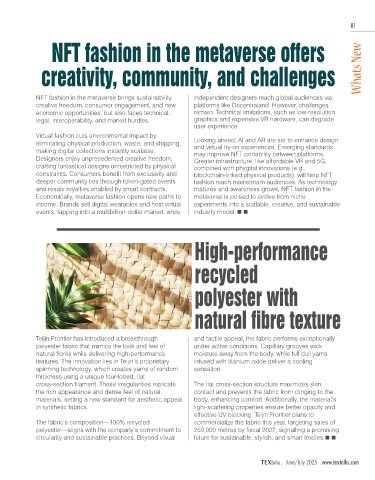
 regenerated fibre                                            natural fibre texture


 HKRITA (The Hong Kong Research Institute of Textiles and Apparel) and Seiko Epson have unveiled a   Teijin Frontier has introduced a breakthrough   and tactile appeal, the fabric performs exceptionally
 pioneering breakthrough in sustainable textiles by creating high-quality regenerated cotton fibre from discarded   polyester fabric that mimics the look and feel of   under active conditions. Capillary grooves wick
 fabrics. This innovation, combining Epson’s dry fiber defibration technology with HKRITA’s fibre-dissolving   natural fibres while delivering high-performance   moisture away from the body, while full dull yarns
 expertise, results in a luxurious, silk-like material crafted entirely from cotton waste.   features. The innovation lies in Teijin’s proprietary   infused with titanium oxide deliver a cooling
            spinning technology, which creates yarns of random   sensation.
 The process begins by converting discarded cotton textiles into a fine powder using Epson’s proprietary dry   thickness using a unique four-lobed, flat
 fiber technology. HKRITA’s method then dissolves this powder and regenerates it into new fibres through wet   cross-section filament. These irregularities replicate   The flat cross-section structure maximizes skin
 spinning. These regenerated fibres offer both the strength of cotton and the smooth texture of silk, making them   the rich appearance and dense feel of natural   contact and prevents the fabric from clinging to the
 ideal for premium products like scarves, ties, and suit linings.  materials, setting a new standard for aesthetic appeal   body, enhancing comfort. Additionally, the material’s
            in synthetic fabrics.                             light-scattering properties ensure better opacity and
 What sets this approach apart is its ability to use short fibres, which are typically discarded in traditional   effective UV blocking. Teijin Frontier plans to
 recycling methods. By reusing this portion of cotton waste, the process significantly boosts recycling efficiency   The fabric’s composition—100% recycled   commercialize the fabric this year, targeting sales of
 and supports a circular economy in fashion. The regenerated fibre will be showcased globally, with industry   polyester—aligns with the company’s commitment to   250,000 metres by fiscal 2027, signalling a promising
 experts hailing it as a major stride in eco-conscious fashion innovation.  circularity and sustainable practices. Beyond visual   future for sustainable, stylish, and smart textiles.


 June/July 2025                                                                            June/July 2025

