


Page 96 - TEXtalks September/October 2021
P. 96
96
                                                                                                                                        Textile-based


                                                                                                                                     battery powered


                                                                                                                                    by Human Sweat


                                                                                                                                   Scientists from the Nanyang Technological
                                                                                                                                   University, Singapore (NTU Singapore) have
                                                                                                                                   developed a soft and stretchable battery
                                                                                                                                   attached to an absorbent textile substrate
                                                                                                                                   powered by human perspiration. The
                     Washable smart clothes                                                                                        flake electrodes that generate electricity in
                                                                                                                                   prototype battery consists of printed silver
                                                                                                                                   the presence of sweat. Measuring 2 cm by 2
                                                                                                                                   cm and as flat as a small paper bandage,
                                powered by Wi-Fi                                                                                   the battery is affixed to a flexible and sweat
                                                                                                                                   absorbent textile that is stretchable and
                                                                                                                                   attachable to wearable devices, like watch-
                                                                                                                                   es, wrist bands, or arm straps, NTU Singa-
                                                                                                                                   pore said in a press release.

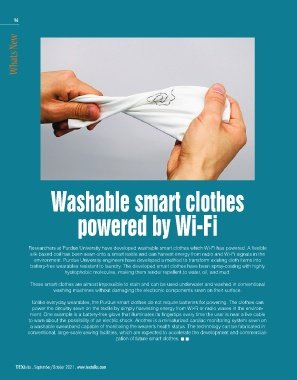
            Researchers at Purdue University have developed washable smart clothes which Wi-Fi has powered. A flexible             The scientists tested their device with
             silk-based coil has been sewn onto a smart textile and can harvest energy from radio and Wi-Fi signals in the         artificial human sweat to demonstrate its
               environment. Purdue University engineers have developed a method to transform existing cloth items into             potential use when incorporated in wearable
             battery-free wearables resistant to laundry. The developed smart clothes have been spray-coating with highly          biosensors and other electronic devices.
                           hydrophobic molecules, making them render repellent to water, oil, and mud.                             Researchers have reported that an individu-
                                                                                                                                   al wearing the battery around their wrist and
             These smart clothes are almost impossible to stain and can be used underwater and washed in conventional              cycling on a stationary bicycle for 30
                      washing machines without damaging the electronic components sewn on their surface.                           minutes was able to generate a voltage of
                                                                                                                                   4.2 V and output power of 3.9 mW that was
              Unlike everyday wearables, the Purdue smart clothes do not require batteries for powering. The clothes can           sufficient to power a commercial tempera-
              power the circuitry sewn on the textile by simply harvesting energy from Wi-Fi or radio waves in the environ-        ture sensor device and send the data
             ment. One example is a battery-free glove that illuminates its fingertips every time the user is near a live cable    continuously to a smartphone via Bluetooth.
            to warn about the possibility of an electric shock. Another is a miniaturized cardiac monitoring system sewn on
             a washable sweatband capable of monitoring the wearer's health status. The technology can be fabricated in            The battery could help reduce harmful
            conventional, large-scale sewing facilities, which are expected to accelerate the development and commerciali-         electronic waste, as it does not contain
                                               zation of future smart clothes.                                                     heavy metals or toxic chemicals. The
                                                                                                                                   scientists behind it believe it could lead to
                                                                                                                                   innovation within the wearable tech industry.

               September/October 2021

