

The Italian investment integrates web formation and converting in a single production system, targeting higher absorbency, consistent quality and growth in specialised food-packaging materials.
MAGIC S.p.A. has ordered a new food-pad production line from ANDRITZ for its facility in Oleggio, Italy, with commissioning scheduled for the first quarter of 2027.
The order covers an ANDRITZ food pad eXcelle line incorporating airlaid web-forming technology. MAGIC produces absorbent materials for food packaging, medical devices, personal care and hygiene applications. The contract value was not disclosed; ANDRITZ recorded the order in the third quarter of 2025.
Airlaid moves into the core
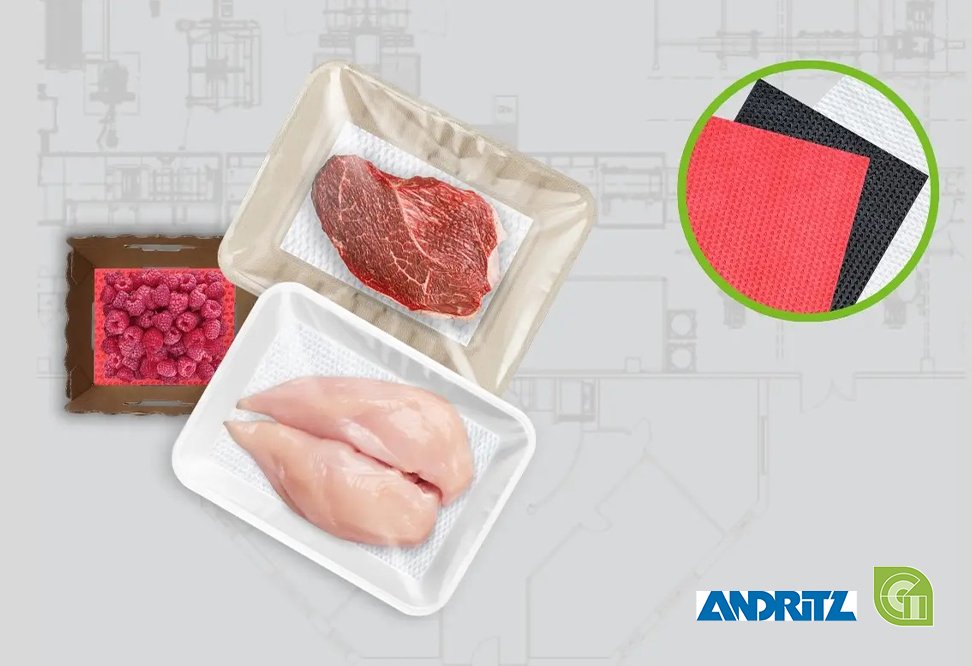
Food pads are used beneath products such as meat, fish, fruit and poultry to absorb liquid released during storage and transport. Their performance depends on rapid fluid uptake, retention under pressure, pad integrity and compatibility with food-contact requirements.
Airlaid technology forms a web by dispersing fibres in an air stream rather than suspending them in water. This allows producers to engineer absorbent structures using pulp and other fibres while controlling basis weight, uniformity and product architecture.
ANDRITZ supplies complete airlaid lines, forming units, defibration systems, dryers and fibre-recycling technologies. Its airlaid systems are used across food pads, wipes, hygiene products, tableware and moulded-fibre packaging.
Two divisions combine expertise
The new system was jointly engineered by ANDRITZ Diatec and ANDRITZ Dan-Web. The project integrates Dan-Web’s airlaid forming technology with Diatec’s converting platform, creating a continuous production concept rather than treating web formation and pad assembly as separate operations.
MAGIC said the integrated approach was an important reason for selecting ANDRITZ, as it is expected to improve product quality and support expansion in absorbent food-packaging markets.
Performance will determine the return
Neither company disclosed line speed, output capacity, fibre composition, pad dimensions or expected productivity gains. Commercial success will depend on whether the system improves absorbency consistency while limiting fibre waste, downtime and conversion costs.
The 2027 start-up will therefore be the key test. Reliable integration could strengthen MAGIC’s position in specialised nonwovens and demonstrate how airlaid technology can create higher-value applications beyond conventional hygiene products.
