

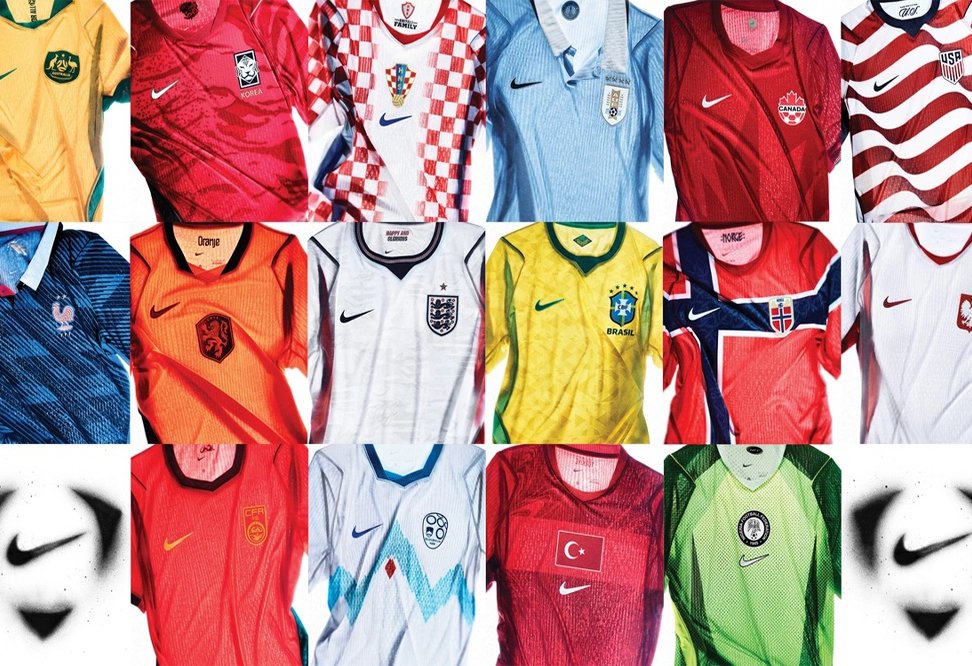
The uniforms are a technical milestone for textile-to-textile recycling, but they also show why circular fashion cannot be solved by chemistry alone.
Nike’s 2026 federation football kits will put chemically recycled polyester on one of sport’s biggest stages. The company says the kits and accompanying Aero-FIT training collections are its first elite performance apparel made from 100% textile waste, using advanced chemical recycling to create recycled polyester yarn with virgin-like quality. Nike also claims its Aero-FIT cooling system delivers more than twice the airflow of legacy fabrics through yarn- and stitch-level engineering.
A breakthrough with boundaries
The launch matters because most recycled polyester in fashion still comes from plastic bottles, not old garments. Textile-to-textile recycling is the more credible circular route: waste clothing becomes new clothing, rather than diverting PET bottles from bottle-to-bottle recycling. Nike has also signed supply agreements with chemical-recycling firms Syre and Loop Industries, signalling that large brands now want textile-waste feedstocks rather than bottle-based claims.
Yet Grist’s reporting makes clear why the industry should be cautious. Chemical recycling works best with clean, well-sorted, polyester-rich waste. Post-consumer clothing is far messier: blends, elastane, cotton, nylon, coatings, dyes, zippers, trims and labels all create sorting and pre-treatment challenges.
Scale is the real test
The larger problem is volume. Textile Exchange estimates global fiber production reached 132 million tonnes in 2024 and could hit 169 million tonnes by 2030 under business-as-usual growth. Polyester remained the largest fiber category, representing 59% of global fiber output, while less than 1% of the global fiber market came from pre- and post-consumer recycled textiles.
That gap is critical. Even successful chemical recycling would struggle to offset growth if brands keep expanding polyester consumption. Circular feedstock can reduce virgin input, but it cannot neutralise overproduction.
The transparency issue
The Nike kits are useful as a performance proof point, especially for high-visibility, tightly controlled products such as national-team uniforms. But the sector still needs clearer disclosure on feedstock sources, process yields, energy demand, chemical inputs, cost, durability and end-of-life pathways.
The next signal to watch is whether Nike and its recycling partners move from elite capsules to audited, scalable supply chains. Without that, chemically recycled polyester risks becoming a showcase innovation: impressive on the pitch, but too small to change fashion’s material economy.
