

The project is not a replacement for industrial dyeing yet—but it offers a serious research direction for colour, knit engineering and biofabrication.
OXMAN’s Vigils research platform proposes a different route to textile coloration: rather than applying dye to finished fabric, it grows pigment directly on a seamless 3D-knitted textile using engineered bacteria. The project uses an engineered strain of Escherichia coli to produce indigo and melanin pigment classes, with the living culture active for roughly 24 hours before the garment is worn.
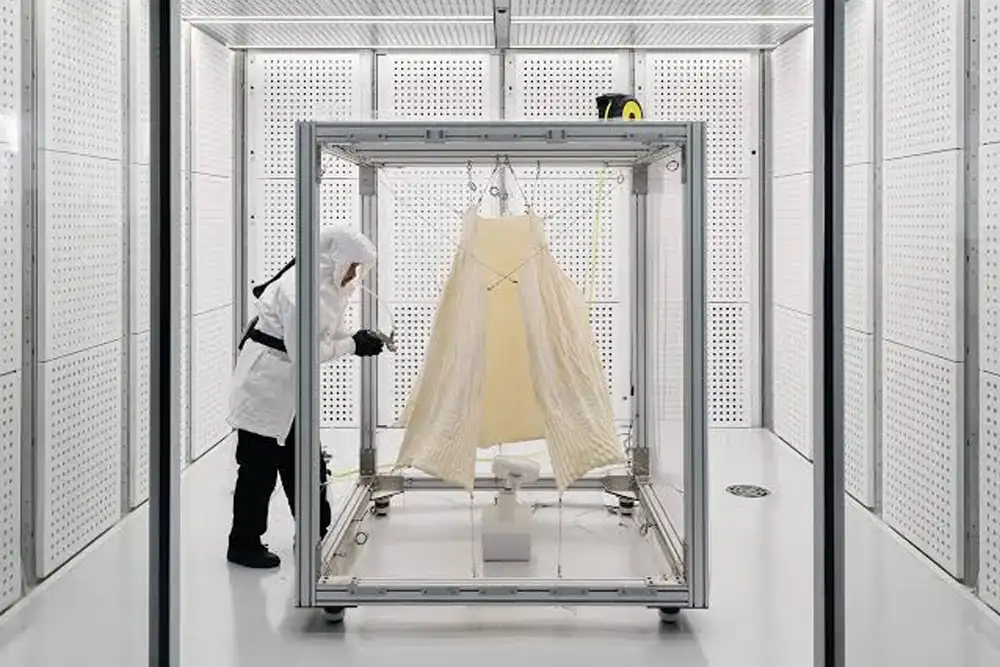
Presented through four experimental cape-like garments, called Velum I–IV, Vigils combines knitting architecture, microbial growth and programmed chemical signals in a single material-development process. The result is less a conventional dyed textile than a biological record of pigment formation across a structured surface.
The fabric becomes the process vessel
The technical idea is important. In Vigils, the knitted construction is not merely a substrate. Its ridges, valleys, yarn geometry and local chemical treatment influence where bacterial cultures grow and where pigmentation develops. OXMAN describes the textile as a “bioreactor”: a fibre architecture on which cells can sense their environment and deposit material locally.
That approach could eventually alter how mills think about product development. Knit topology, fibre chemistry, chemical finishing and visual design may increasingly be engineered together rather than handled as sequential operations.
Beyond colour: a programmable-material proposition
Pigmentation is only the first demonstration. OXMAN argues that comparable biological programming could, in principle, be applied to biomineralisation, enzymatic cross-linking and the local production of functional proteins. Such applications could open routes to selectively stiffened, softened or functionally modified textiles.
For technical-textile and apparel manufacturers, the longer-term opportunity is not simply “bio-dyeing”. It is the possibility of producing differentiated material properties precisely where they are needed, within the same textile structure.
Industry still needs proof at scale
The commercial barriers remain substantial. Recent research on microbial pigments identifies high production costs, low pigment yields, inconsistent fixation, stability issues and a lack of standardised industrial dyeing methods as major constraints. Wash fastness, light fastness, reproducibility, biosafety, process control and lifecycle impacts would all need rigorous verification before such systems can move beyond controlled research settings.
Vigils is therefore best understood as an advanced material-research signal. It suggests that the next frontier in textile innovation may not be a better dye recipe alone, but a shift from colouring fabric after manufacture to programming colour and function into the making of the textile itself.
