

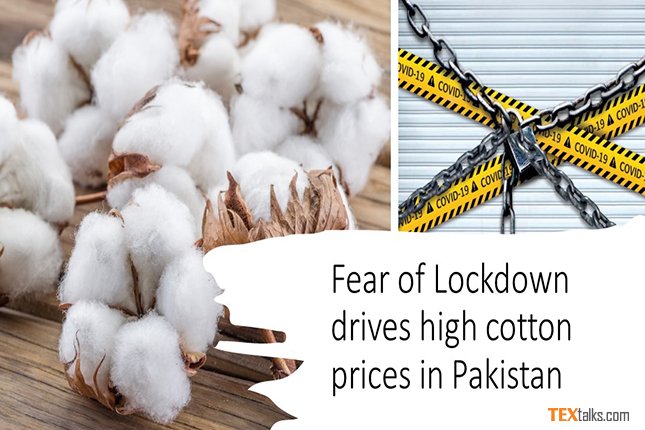
COVID-19 cases are increasing in Pakistan, and Government has hinted at the upcoming lockdown.
The news has hit the textile industry, which is already facing severe challenges. Lack of interest among buyers remained persistent in the local cotton market during the outgoing week, but some lots of quality lint were sold, which caused the spot rate to rise by Rs500 per maund.
Due to the pandemic, the Government imposed a smart lockdown, and trade decreased in the local market. The traders are less interested, as they are afraid amid assumptions for a complete lockdown.
Last year several industries were closed while textile mills also remained shut for one to two months. Thus, fear of the lockdown has kept the traders on the backfoot.
Cotton prices in Sindh remained at Rs10,200 per maund to Rs10,600 per maund. Rates in Punjab varied between Rs10,800 per maund to Rs11,500 per maund. Some good quality isolated lots and sales on credit were also recorded at Rs12,000 per maund.
Spot committee of the Karachi Cotton Association increased the spot rate by Rs500 per maund to Rs11,300 per maund.
On the other hand, there was positive news that the private sector is also interested in getting the cotton production increased along with the public sector. Pakistan Cotton Ginners Association is also active and has formed a task force for the growers’ awareness.
Besides, the Federation of Pakistan Chambers of Commerce and Industry’s regional cotton committee and textile and the cotton sector is active and held meetings. In addition, government departments have also become energetic and they have shown interest in increasing cotton production. In contrast, the Government has allocated Rs10 billion to enhance cotton production, which would be spent on seed production and subsidy to the farmers.
Naseem Usman, Chairman Karachi Cotton Brokers Association, told The News that prices in the international market were almost increasing and stable in some markets. US exports dropped 16 percent during the week due to dollar depreciation and the drought-like situation in the largest cotton-growing Texas Estate.

