

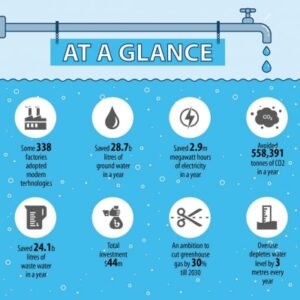
Partnership for Cleaner Textile (PaCT) is a flagship program of the private sector lending arm of the World Bank Group. Bangladesh’s textile and garment factories have significantly cut water and energy consumption and saved 28.7 billion liters of water per year.
About 338 washing, dyeing, spinning, weaving, and garment factories in Bangladesh have adopting low-cost and cleaner production processes and installing new technologies under a program initiated by the International Finance Corporation (IFC).
Under the PaCT-2 program, the mills and factories slashed wastewater discharge by 24.1 billion liters. Participating mills and factories invested million for the purpose.
Similarly, the factories are saving 2.9 million megawatt-hours (MGh) of electricity annually and avoiding 558,391 tonnes of carbon emission, according to data from the PaCT. Urmi Group of textiles Bangladesh currently consumes 60 liters of water to dye one kg knit fabrics, way down from 100 liters to 105 liters needed two years ago.
 The PaCT supports the entire textile value chain – spinning, weaving, wet processing, and garment factories — in adopting cleaner production practices.
It focuses on reducing the environmental impact and resource consumption.
The PaCT is the first program ever to incorporate cutting-edge innovations to address the environmental and sustainability challenges related to the textile sector.
Apart from the sector’s participation in the initiatives regarding climate change and circularity, the Bangladesh Garment Manufacturers and Exporters Association (BGMEA) has also taken a pledge to sustainability, said Rubana Huq, the immediate past president of the association. In collaboration with the UNDP and the Global Reporting Initiative, a survey to develop a report highlighting the impact of ready-made garment factories on the Sustainable Development Goals was conducted. The BGMEA has joined the UN Climate Change and the Fashion Industry Charter for Climate Action with an ambition to reduce GHG emissions by 30 percent by 2030.

