

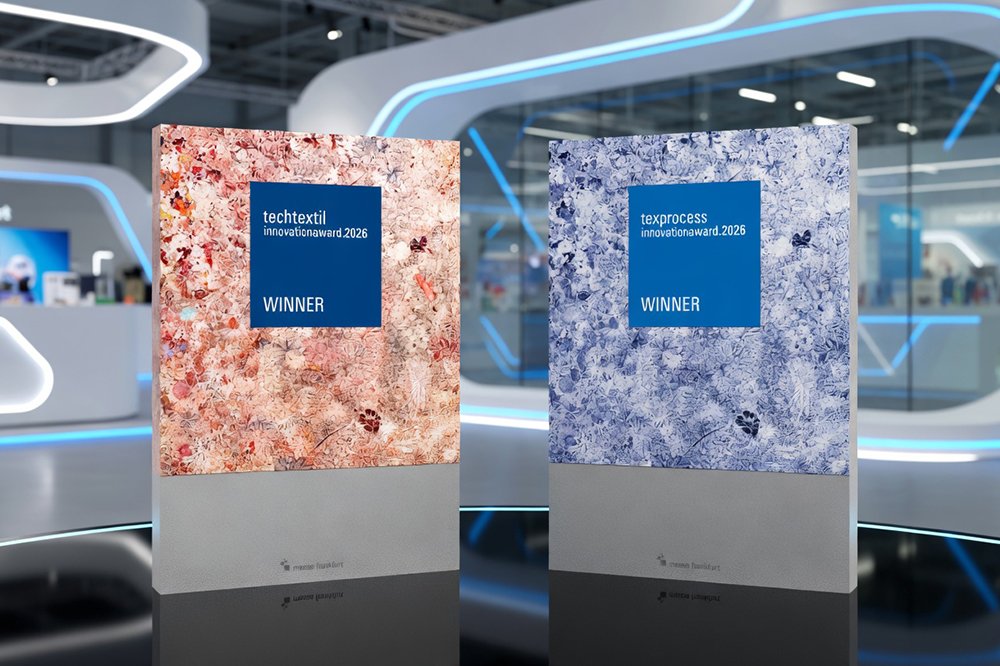
The 2026 winners suggest the next phase of textile competition will be shaped less by incremental change and more by chemistry shifts, circular feedstocks, automation and cross-industry applications.
The Techtextil and Texprocess Innovation Awards 2026 have named 17 winners across 10 categories, offering a clear snapshot of where the textile industry’s innovation agenda is moving. Announced by Messe Frankfurt ahead of the fairs in Frankfurt from April 21–24, the awards highlight technologies with applications extending well beyond textiles into automotive, aerospace, medical, construction, architecture and robotics.
The strongest theme is the industry’s push to replace problematic chemistry without losing performance. Among the most commercially relevant winners are Bäumlin & Ernst’s EC0Tex, a PFAS-free plasma-based water-repellent yarn-finishing process that avoids fresh water, and H&B Materials’ plant-based, PFAS-free water repellency chemistry derived from agricultural waste. Both point to how urgently the market is looking for scalable alternatives as PFAS restrictions tighten in Europe and beyond.
A second major signal is circularity. The awards recognized Samsara Eco’s enzyme-based recycling platform for polyester and nylon, and re.solution’s electrochemically assisted hydrolysis process for mixed textile waste, which aims to cut chemical use, water consumption and salt waste in polyester recovery. These wins reflect a broader industry shift: the recycling challenge is no longer just about proving chemistry in the lab, but about improving economics and industrial practicality.
Materials innovation also stood out. Winners included Senbis’ Mariva biodegradable performance biopolyester and FormLig – Knitted Wood, a lignin-coated knitted composite developed for compostable, microplastic-free applications. On the processing side, Fibre Extrusion Technology won for a cleaner UHMWPE gel-spinning process using supercritical CO2 instead of toxic solvents.
Texprocess winners showed the same pattern in manufacturing: Robotextile’s automated fabric singulation gripper, AiDLab’s WiseEye AI inspection system, Amann’s AeoniQ Fil cellulose sewing thread for monomaterial design, and digital tools from Vizoo and CITEVE all targeted labor intensity, quality control and traceability bottlenecks.
The broader message is clear. Textile innovation is no longer being judged only by fabric novelty. Increasingly, it is being rewarded for solving real industrial problems in sustainability, automation, compliance and circularity.
