

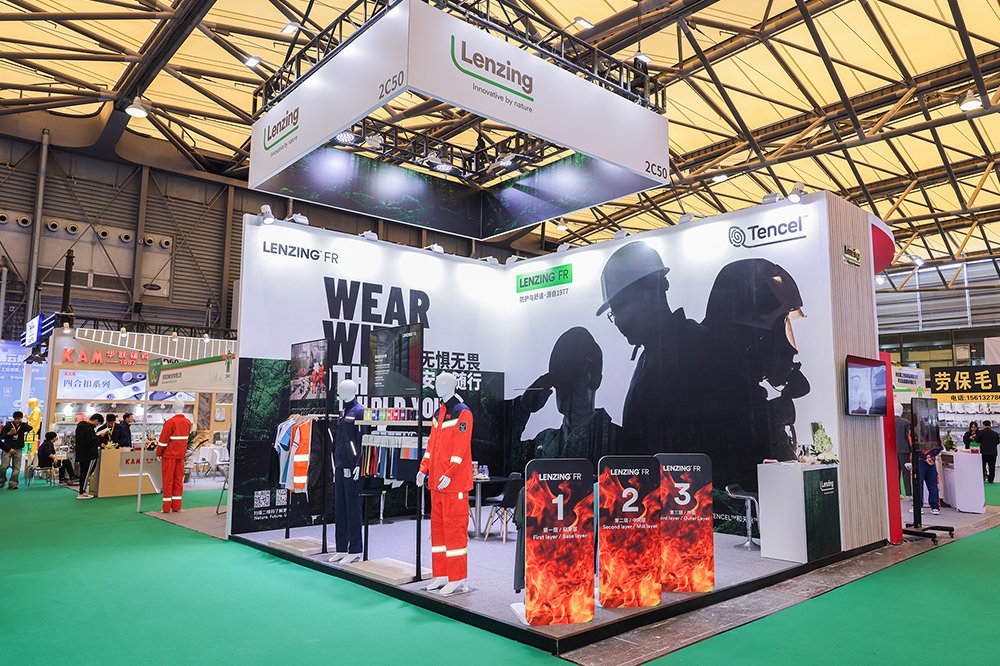
The Austrian fiber producer is moving beyond a single-product flame-resistance offer and toward a broader protective-wear architecture spanning high-risk, industrial and cost-sensitive applications.
Lenzing has launched Lenzing Solutions for Protective Wear, a new three-tier portfolio built around LENZING™ FR fibers for the highest protection tier and complemented by TENCEL™ Lyocell-based options for hybrid and FR-finished applications.
The commercial logic is straightforward. Protective clothing demand is widening across firefighting, utilities, oil and gas, welding, military and industrial applications, but those end uses do not require the same material architecture. Lenzing is trying to turn that reality into a clearer product strategy: inherent protection with LENZING™ FR for the highest-risk environments, hybrid protection using TENCEL™ Lyocell A100 blends for comfort-focused FR applications, and FR-finished protection using standard TENCEL™ Lyocell for more cost-sensitive industrial categories. Lenzing links the launch to a global PPE market that third-party forecasts place at roughly $129 billion by 2034, underscoring why the segment matters strategically.
At the top tier, the company is leaning heavily on the long-established position of LENZING™ FR, which it says has been in the market since 1977 and is protected by European patent EP 2473657 B1. Lenzing argues that inherent FR protection removes the need for wash-cycle tracking and offers stronger durability than treated alternatives. The company also cites internal and independent data showing lower heat stress in blends containing LENZING™ FR versus FR-treated cotton, 100% aramid and modacrylic-cotton blends under controlled testing.
The broader significance is that Lenzing is trying to reposition cellulosic fibers as a more complete PPE platform rather than a niche comfort component. That may resonate as buyers face tighter scrutiny over PFAS, traceability and worker heat stress, while still demanding category-specific performance and cost discipline. For Lenzing, the next challenge is adoption: turning a well-structured fiber story into specification wins across different protective-wear segments.
