

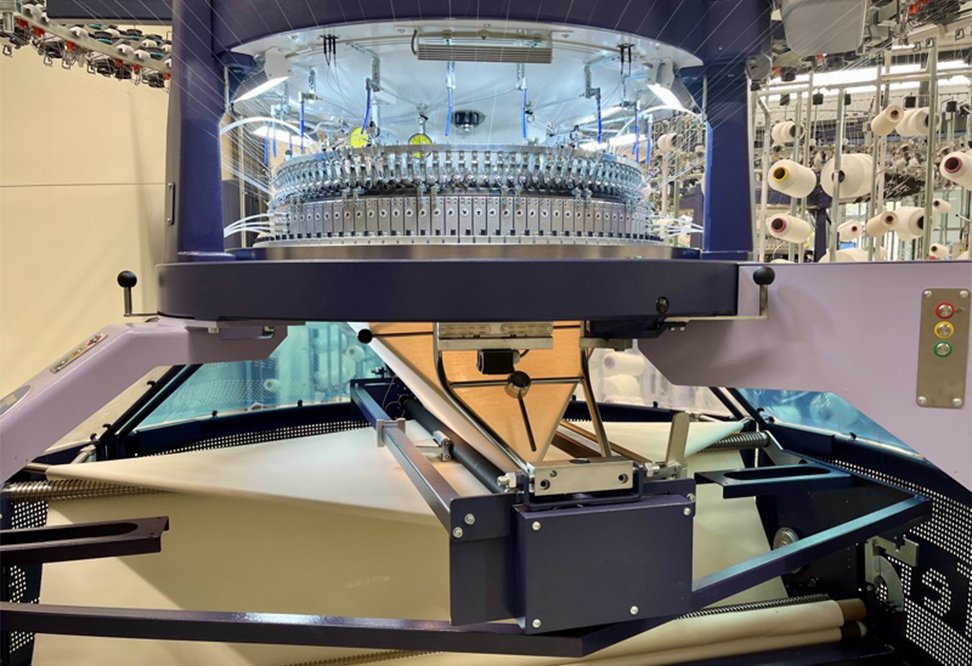
The company’s ITM display will focus on higher-output double-knit production, functional fabric engineering and faster response to performancewear demand.
Terrot will present its latest circular knitting technology at ITM Istanbul 2026, taking place from June 9–13 at the Tüyap Fair Convention and Congress Center, as machinery makers prepare to showcase new productivity and automation solutions for global textile manufacturers. The German circular knitting specialist will exhibit as part of the Santoni China Group, reinforcing its position in premium engineered knitting systems.
I3P platform moves forward
At the centre of Terrot’s presentation will be the open-width I3P 196-F BW, 34-inch, E24, 108F machine, an advanced development of the company’s established high-system I3P 196 platform. The machine is designed for sophisticated double-knit structures and higher production output while maintaining fabric precision and consistency.
The broader I3P 196 platform is known for producing structures such as 8-lock, interlock, double face, Punto di Roma, Milano rib, Piqué Rodier and racer mesh, supported by flexible patterning options through multiple needle tracks in cylinder and dial cams.
Functional fabrics in focus
A key highlight at ITM will be a newly developed double-face fabric produced on the machine. By integrating an additional synthetic yarn, the fabric is engineered for improved moisture management, breathability, elasticity, shape retention and wear comfort.
These properties position the fabric for higher-value end uses, including outerwear, sportswear, leisurewear and thermal garments. For mills, the commercial relevance is clear: machinery investment is increasingly judged not only by speed, but by the ability to produce differentiated fabrics for brands that want comfort, performance and consistent quality at scale.
Productivity and flexibility
Terrot Managing Director Martin Vorsatz said the company’s strength lies in engineering excellence and double-knit application expertise, while the Santoni China Group structure gives customers access to a broader integrated ecosystem.
The next test for Terrot’s technology will be how mills translate higher system counts and fabric versatility into measurable gains: shorter production cycles, lower changeover friction, fewer quality deviations and faster sampling-to-order conversion. For manufacturers serving activewear and functional apparel buyers, that combination may matter as much as machine speed itself.
