

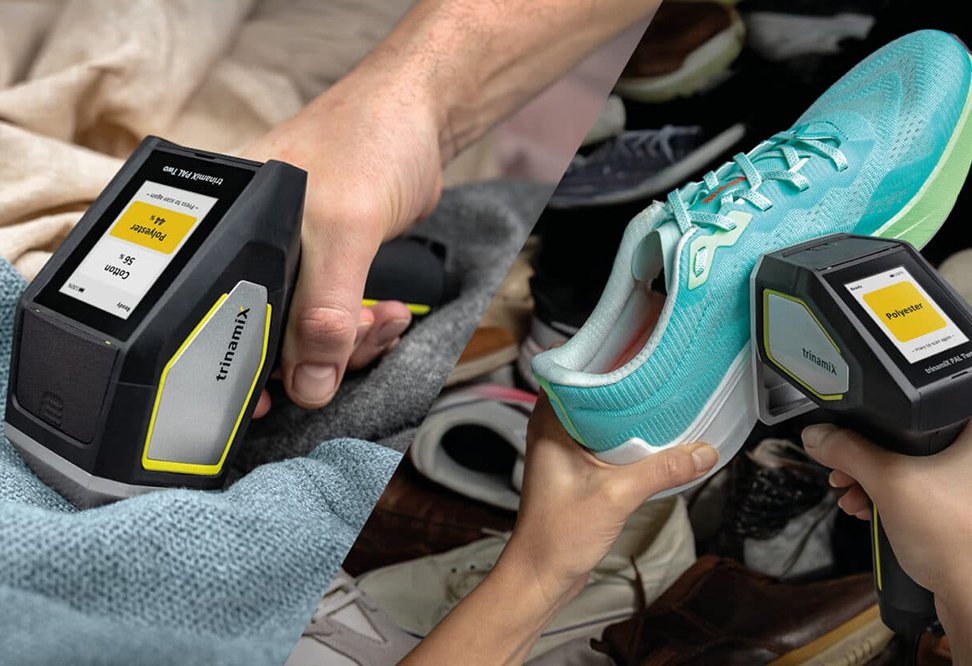
The new application enables on-site identification of textile blends and shoe components, giving manufacturers and recyclers faster material data for sorting, compliance and circularity.
trinamiX GmbH is expanding its mobile near-infrared spectroscopy portfolio with new applications for the textile and footwear industries. The solution allows manufacturers, sorters, recyclers and brand owners to identify material composition within seconds, addressing one of the biggest barriers to textile circularity: reliable, decentralised material recognition.
The textile application will be available from May 2026 and is designed for textile and carpet manufacturers, sorting facilities and recycling companies.
Faster identification for complex products
Modern textiles and shoes are increasingly difficult to classify by visual inspection. Footwear may combine ethylene vinyl acetate, polyester, polyurethane and multi-layer structures. Textile products often contain blended fibres such as cotton/polyester or viscose/polyester, where composition determines the appropriate recycling route.
trinamiX’s handheld NIR device enables non-destructive, on-site testing across incoming inspection, production, sorting and recycling operations. For binary textile blends, the system can quantify fibre shares as percentages, supporting more accurate sorting and validation of material declarations.
Recycling quality depends on cleaner streams
Material contamination is a major challenge in textile and footwear recycling. Incorrectly sorted fibres can reduce recycled-yarn quality, limit closed-loop use and push materials into lower-value downcycling. By identifying materials quickly at the point of handling, mobile NIR can improve separation accuracy and reduce reliance on manual sorting.
For footwear, the technology can help classify components before recycling or repair decisions are made. For textiles, it can support sorting by fibre type, blend ratio and recycling suitability—critical as more brands set recycled-content targets and prepare for stricter product-data requirements.
A data layer for circular systems
The system combines a handheld spectrometer, mobile app, cloud-based analysis and customer portal for documentation and data export. Standardised interfaces allow integration into existing software environments, making the technology relevant not only for recycling operations but also for Digital Product Passport readiness and sustainability performance reporting.
The next test is adoption at industrial scale. If mobile NIR becomes widely deployed across sorting centres, mills and brand supply chains, it could help close the information gap that currently limits textile-to-textile recycling and higher-value material recovery.
