

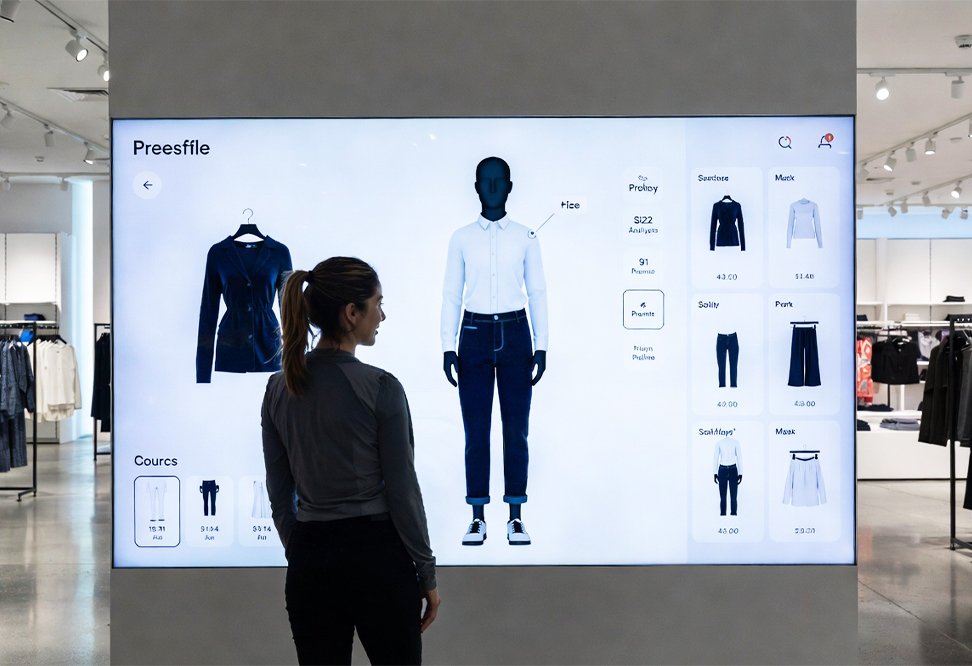
The commercial value is not a digital mirror alone; it is better size confidence, stronger conversion and fewer avoidable returns.
Virtual fitting room technology is expected to become a larger part of fashion retail’s digital infrastructure as brands seek to reduce uncertainty in online apparel purchases. The Business Research Company forecasts the global market will grow from US$9.38 billion in 2026 to US$21.01 billion by 2030, at a 22.3% annual rate.
The forecast should be treated cautiously. Market estimates vary widely between research providers. Yet the direction is clear: apparel retailers are investing in virtual try-on, AI sizing, 3D body-data tools and connected in-store mirrors because fit remains one of the largest barriers to buying clothing online.
Visual try-on is not fit accuracy
The sector contains three distinct technologies that are often grouped together. Virtual try-on allows shoppers to visualise a garment on an avatar or uploaded image. Fit-recommendation tools use purchase history, body inputs and brand-specific sizing data to suggest a size. More advanced systems combine body measurement or 3D scanning with garment data to assess likely fit.
These functions create different commercial outcomes. A visually convincing image can improve engagement, but it does not necessarily predict ease, stretch, drape or comfort. For brands, the priority is to avoid confusing appearance simulation with reliable size recommendation.
Product data becomes the real asset
Virtual fit systems are only as reliable as the data behind them. Brands need accurate garment measurements, graded size specifications, fit blocks, fabric-stretch information, construction details and consistent product imagery. Mills and garment manufacturers may therefore become more involved in supplying structured product data alongside fabrics and finished goods.
This has implications for exporters. A supplier able to provide digital specification packs, consistent measurement data and fabric-performance information can support customers’ virtual-fit platforms more effectively than one supplying physical samples alone.
Returns reduction requires proof
The strongest business case is lower returns, but this should be measured rather than assumed. Fit tools can improve conversion and reduce size-related returns where they are calibrated to a brand’s patterns and customer base. Poor recommendations, unclear consent practices or weak integration with product data can have the opposite effect.
The next phase will be less about eye-catching AR mirrors and more about scalable deployment across product categories, sizes, body types and markets. Retailers that connect virtual fitting to trustworthy product information, privacy controls and post-purchase return data will be best placed to turn technology into margin improvement.
