

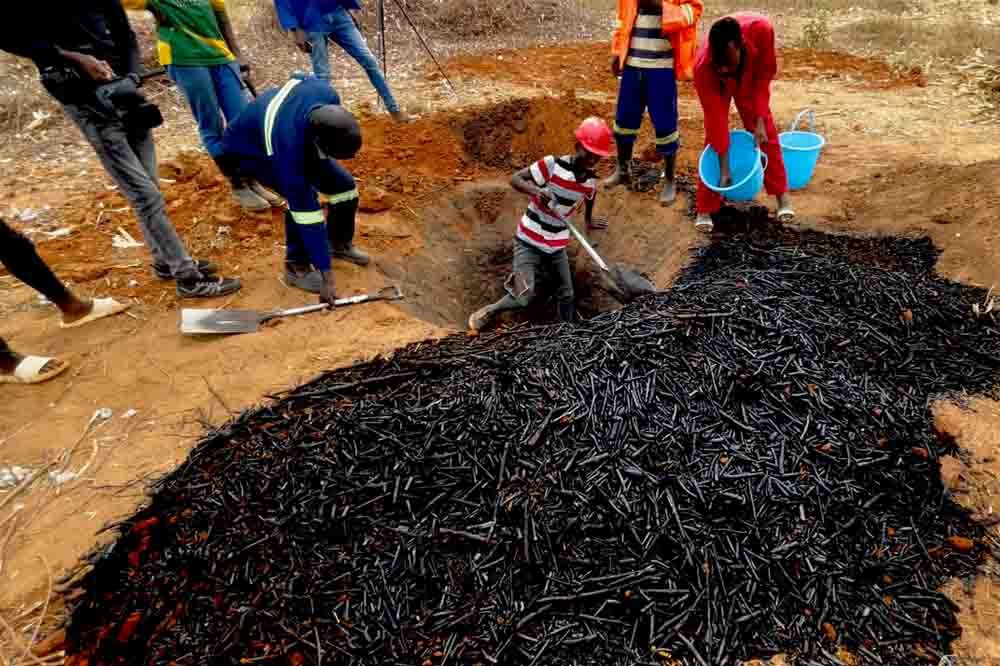
A simple technique called a ‘Cone-Pit Open Earth Kiln’, originally proposed by Schmidt and Taylor (Ithaka Journal, 2014), was standardized by the ICAC for rapidly turning cotton stalks into biochar without any infrastructure. The low-cost technique, which can rejuvenate soil health and improve yields, is spreading throughout Africa and Asia. The most recent practical training session on the technique was held in Yamoussoukro, Cote d’Ivoire, on 13 April 2023, for the staff of multiple organizations.
buy zocor online https://azpsych.org/general/october/html/zocor.html no prescription pharmacy
Before that, the ICAC conducted a three-day training course for a different group of participants in March 2023 in Kushtia, Bangladesh.
buy strattera online https://azpsych.org/general/october/html/strattera.html no prescription pharmacy
The ICAC scientists standardized the cone-pit open earth kiln technique for producing biochar from cotton stalks after being inspired by a path-breaking research paper authored by Schmidt and Taylor (2014). This technique was used in a project titled ‘Doubling small-farmer yields in Zambia,’ which was funded by the ITC-EU and implemented by CDT and CBZ in Zambia. Mr. Martin Simasiku, Mr. Lwisya Silwimba, Mr. Derrick Sichilima, Mr. Dafulin Kaonga, and Mr. Sunduzwayo Banda provided leadership for the initiative in Zambia.
buy cialis professional online https://azpsych.org/general/october/html/cialis-professional.html no prescription pharmacy
The ICAC has recently initiated a project called ‘Adapting Innovations for Resilience to Climate Change for Smallholder Cotton Farmers (i4Ag-AIRCoA)’ carried out by ICAC and CIRAD on behalf of Deutsche Gesellschaft fur Internationale Zusammenarbeit (GIZ) GmbH through the “Innovation for Agriculture” (i4Ag) Program, funded and commissioned by the German Federal Ministry for Economic Cooperation and Development (BMZ) to produce biochar and use it in regenerative agriculture to enhance yields in at least 4,800 demonstration fields of one acre each in Cameroon and Cote d’Ivoire during three years from December 2022 to December 2025. The project aims to promote the use of biochar as a sustainable soil amendment and carbon sequestration tool while enhancing the resilience of smallholder cotton farmers to climate change.
buy priligy online https://esishow.com/wp-content/uploads/2025/03/jpg/priligy.html no prescription pharmacy
According to preliminary results from the ICAC initiatives, biochar produced from cotton stalks was found to be highly alkaline and can effectively remediate acidic soils, improve soil structure, enhance cation exchange capacity, and enrich soil health by adding organic carbon. Although acidic soils can benefit directly from alkaline biochar, the addition of organic matter and manure can further assist in enhancing soil health without the risk of nutrient lockup caused by biochar. In addition to promoting the use of alkaline biochar, the ICAC is also encouraging the adoption of technologies to produce high-quality, nitrogen-rich compost. This can be achieved through aerated matrices using biochar or through an anaerobic process called ‘Bokashi,’ which can produce acidic compost from organic matter within 2-3 weeks and neutralize alkaline biochar, resulting in the quickest possible enrichment of soil organic matter.
