

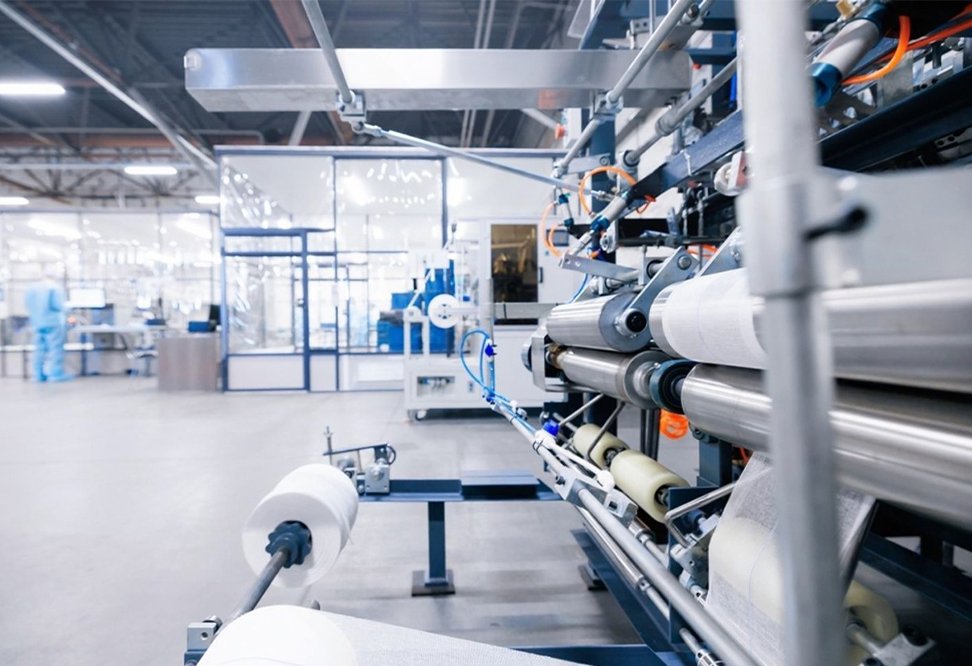
Demand from hygiene, medical disposables, packaging and automation is reshaping investment priorities for nonwoven machinery suppliers.
The global nonwoven fabric machines market is projected to rise from US$2.5 billion in 2026 to US$5.5 billion by 2033, expanding at a 12.2% CAGR, according to Persistence Market Research. Growth is being driven by rising demand for nonwoven fabrics in hygiene, medical, industrial and packaging applications, alongside wider adoption of automated textile manufacturing systems.
Automation becomes the centre of gravity
Automatic machines are expected to dominate the market, accounting for roughly 68–70% of demand in 2026. The shift reflects manufacturers’ need for high-speed output, consistent web formation, lower labour dependence and tighter process control, especially in hygiene and medical-grade production.
For machinery suppliers, this means competition is moving beyond mechanical speed. Digital controls, IoT-enabled monitoring, profile correction, web uniformity and after-sales technical support are becoming key differentiators.
Medical and hygiene demand leads
Medical fibers are projected to hold more than 40% market share in 2026, supported by demand for surgical masks, gowns, drapes, sterilization wraps and wound-care products. Hygiene products such as diapers, sanitary napkins, wet wipes and adult incontinence items remain another major demand base, particularly in urbanizing and ageing markets.
Packaging is also emerging as a fast-growing application as e-commerce expands demand for lightweight, protective, reusable and recyclable materials.
Asia Pacific sets the pace
Asia Pacific is expected to account for 52% of market revenue in 2026, making it both the largest and fastest-growing region. China and India remain central to this expansion because of their large-scale textile, hygiene, medical and packaging manufacturing ecosystems.
Sustainability creates a machinery challenge
The next growth phase will depend increasingly on machines capable of processing biodegradable, recyclable and bio-based fibers. This creates opportunities for equipment makers that can handle wider raw-material variability while maintaining bonding precision, fabric quality and production efficiency.
The main constraint is capability: advanced lines require skilled operators, maintenance teams and process engineers. For textile economies aiming to enter nonwovens, machinery investment alone will not be enough. Training, technical service and process discipline will decide who captures the market.
