

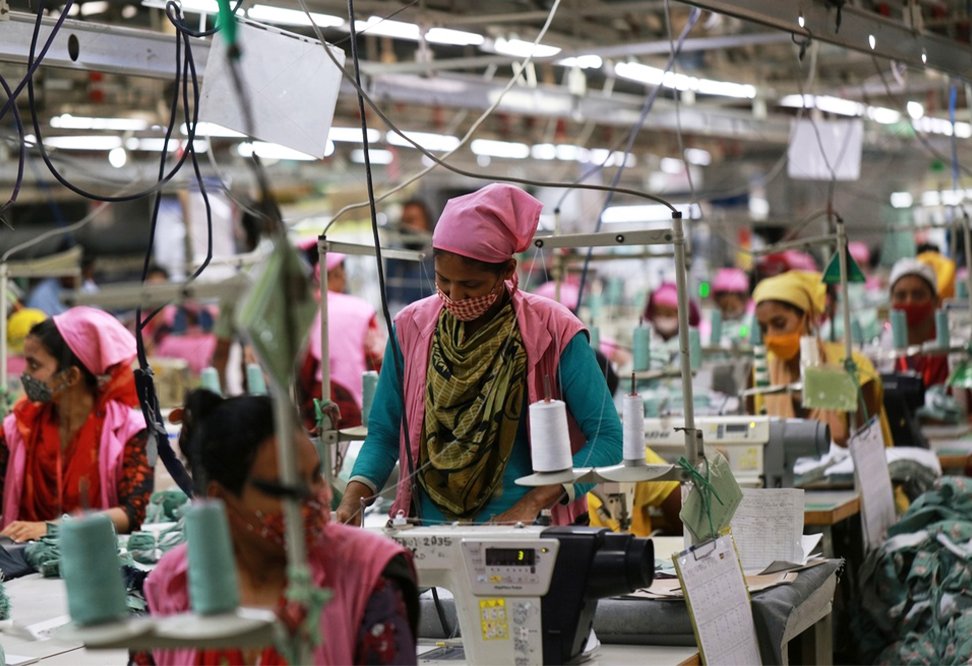
Bangladesh has moved ahead of China in US apparel imports, but the shift reflects China’s much steeper decline rather than outright growth in Bangladeshi shipments.
Bangladesh retained its position as the second-largest apparel supplier to the United States during January–July 2026, exporting $4.66 billion of garments, according to the latest US Office of Textiles and Apparel data.
Its exports nevertheless fell 6.5% year on year. The ranking change came because China’s shipments contracted far more sharply—down 34.2% to $4.55 billion—leaving Bangladesh about $110 million ahead. Total US apparel imports also weakened, falling 8.65% to $41.83 billion.
Vietnam remains dominant
Vietnam remained comfortably the largest supplier, with January–July apparel exports to the US of $9.36 billion, down only 1.03%.
Competition is intensifying further down the ranking. Indonesia increased shipments 2.76% to $2.74 billion, while Cambodia rose 10.48% to $2.62 billion. India fell 25.77% to $2.45 billion, while Pakistan declined 5.60% to $1.26 billion.
This suggests that orders leaving China are being redistributed across several Asian sourcing hubs rather than flowing disproportionately to Bangladesh.
Price pressure tells another story
Bangladesh’s shipment volume declined 4.34%, compared with China’s 24.17% contraction. Average unit prices also fell, but Bangladesh’s decline was limited to 2.26%, versus a much steeper 13.24% fall for China.
The relative price stability indicates that Bangladesh has defended its market position better than China, even as demand remains weak.
Ranking is not yet growth
The July data provides a warning: Bangladesh’s apparel exports to the US fell 10.73% during the month, showing that its No. 2 position does not equate to an expanding order book.
The next competitive battle will therefore be over man-made-fibre apparel, higher-value products, lead times, sourcing flexibility and compliance capability. Bangladesh has gained strategic ground, but Cambodia and Indonesia’s growth shows that the redistribution of US sourcing remains very much in play.
