

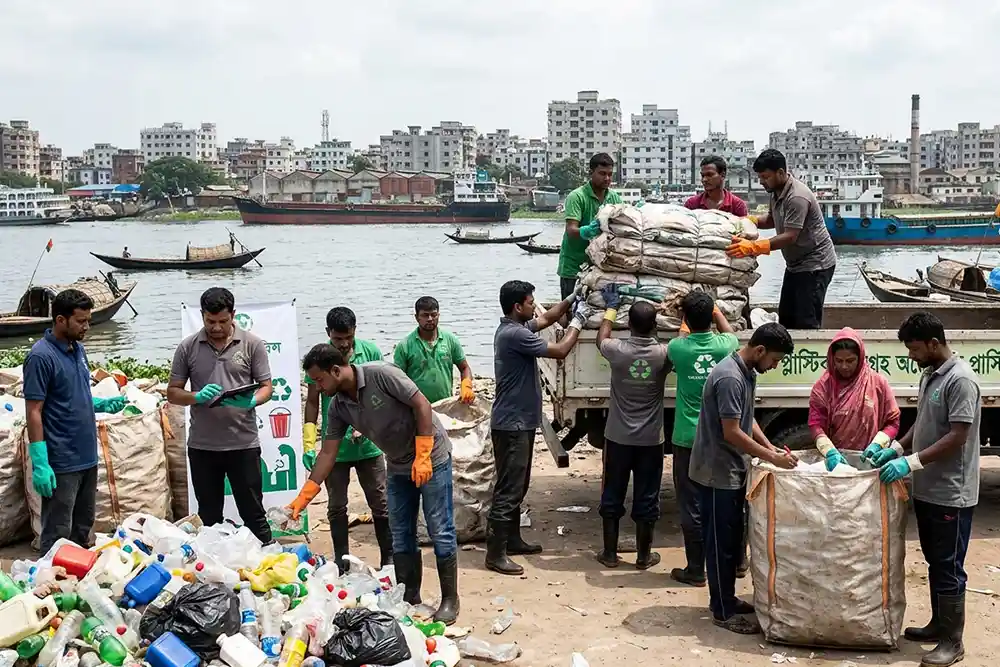
New rules shift responsibility for post-consumer plastic to producers, importers and brand owners, introducing collection, recycling, reporting and plastic-credit obligations that will increasingly affect domestic textile and fashion supply chains.
Bangladesh has introduced a binding Extended Producer Responsibility (EPR) framework for plastic waste, formally transferring part of the cost and responsibility for post-use plastic management from municipalities and consumers to companies placing plastic products on the domestic market.
The EPR Guidelines on Plastic Waste Management 2026 were gazetted on August 13 under Bangladesh’s Environment Conservation Act. They cover recyclable and non-recyclable plastics and apply to manufacturers, importers and brand owners. Export-oriented factories producing exclusively against export orders are exempt.
Collection targets start at 15%
Obligated companies must collect at least 15% of covered plastic waste during the first two years, with at least 7.5% recycled. From years three to five, those targets rise to 30% collection and 15% recycling.
Implementation will be phased: large industrial enterprises enter first, followed by medium-sized companies and eventually small businesses. Once listed by the Department of Environment, companies must register within six months. Registrations remain valid for three years.
Companies can operate their own recovery systems or use registered Producer Responsibility Organisations (PROs) for collection, sorting, recycling and disposal.
Packaging data becomes operational data
The rules cover five broad groups: rigid plastics, flexible plastics, styrofoam/EPS, permitted single-use plastics and other products, including diapers and sanitary products. Flexible packaging, films, wrappers, laminates and multilayer materials are therefore directly relevant to fashion retailers and textile businesses serving Bangladesh’s domestic market.
Companies exceeding recovery targets may generate plastic credits, which can be carried forward or transferred under approved mechanisms. Annual reporting is mandatory; failure to submit progress data can prevent registration renewal.
A new compliance infrastructure
For textile and apparel businesses, the immediate challenge is packaging traceability: knowing how much plastic is placed on the market, by polymer and packaging type, and connecting that data to verified collection and recycling.
Bangladesh’s EPR regime therefore moves packaging from a purchasing issue into a measurable environmental liability. The next test will be the Department of Environment’s digital reporting infrastructure and enforcement of recovery claims.
