

At Amsterdam’s Plastics Recycling Show Europe, the German machinery maker is positioning textile-to-textile PET recycling and lower-cost melt filtration as two of the sector’s most commercially urgent priorities.
BB Engineering will use Plastics Recycling Show Europe 2026 in Amsterdam on May 5–6 to spotlight its PET recycling portfolio, with particular emphasis on textile recycling and melt filtration. The company’s appearance is well aligned with the event’s role as one of Europe’s main showcases for plastics recycling technology, especially in a year when PRSE is marking its 10th edition at the RAI Amsterdam and drawing more than 450 exhibitors from across the recycling value chain.
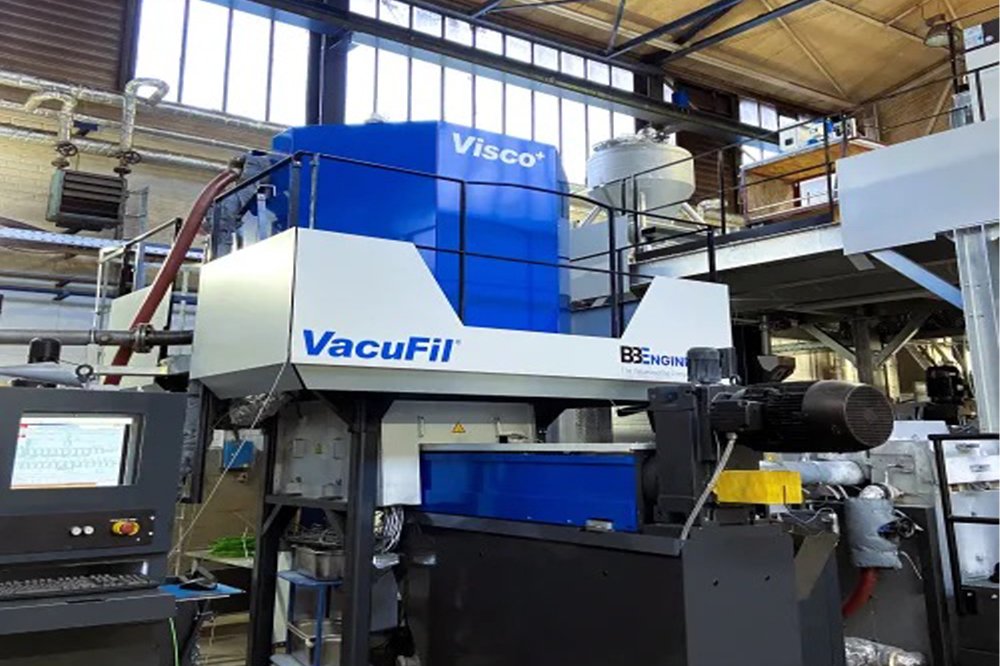
The company’s core message is clear: textile-grade PET recycling needs more precise control over melt quality, viscosity and contamination if it is to scale reliably. BB Engineering says its VacuFil system is designed to process a broad range of PET inputs, including flakes, textile waste, fibre waste and start-up lumps, while enabling targeted intrinsic viscosity adjustment for the desired end product. The company states that the system’s patented Visco+ component uses liquid-state polycondensation to remove volatile contaminants and deliver a homogeneous melt with viscosity control of plus or minus 0.01 dl/g. BB Engineering also says the line can handle capacities from 150 to 4,000 kilograms per hour.
The second pillar is filtration economics. BB Engineering’s COBRA melt filter is being pitched as a response to one of recycling’s persistent operational problems: handling high contamination levels without excessive downtime, chemical cleaning or melt loss. According to the company, COBRA combines continuous large-area filtration with automated intermediate cleaning and dual filter cartridges with automatic switching, allowing uninterrupted operation even where conventional candle filters or screen changers struggle. BB Engineering says this design can reduce energy use, maintenance effort and operating costs while extending filter-media life.
For recyclers and fibre producers, the commercial significance lies in process stability. Textile PET recycling remains harder than bottle recycling because feedstock contamination, colour variability and property consistency all carry higher technical risk. BB Engineering’s strategy at PRSE suggests machinery suppliers increasingly see textile recycling not as a niche extension of PET recovery, but as a distinct investment case requiring dedicated decontamination, viscosity management and filtration performance. The next question is whether recyclers are ready to commit capital at scale as regulatory and brand pressure around textile circularity intensifies.
