

The opportunity is not merely to replace PVA. It is to reduce desizing burdens without adding warp breaks, quality losses or hidden process costs.
The global bio-based warp sizers market could grow from US$295 million in 2026 to US$690 million by 2036, according to a Fact.MR forecast released through a recent industry press statement. The projected 8.9% annual growth rate reflects rising interest in modified starch, cellulose-based formulations and low-PVA sizing systems.
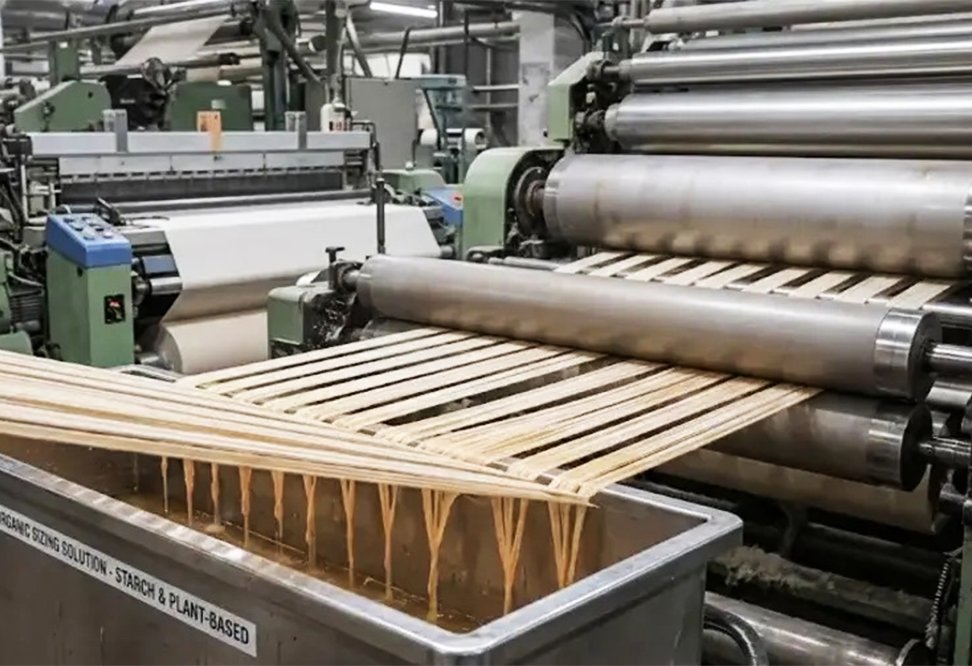
For weaving mills, however, sustainability is only one part of the decision. Sizing chemistry must protect warp yarn against tension, abrasion and repeated friction at high loom speeds while maintaining stable viscosity, controlled add-on, low hairiness and reliable desizing.
Desizing turns chemistry into a cost issue
PVA remains widely used because it provides strong film formation, adhesion and abrasion resistance, especially on polyester-rich and blended yarns. Yet it can create a difficult wastewater profile during desizing, with high chemical oxygen demand and lower biodegradability than starch-based systems.
Starch offers a more renewable and generally biodegradable alternative, particularly for cotton and viscose-rich yarns. Its limitations are equally familiar: brittle films, viscosity variation, ageing behaviour and weaker suitability for some high-speed or synthetic-yarn applications.
This explains why mills still rely on blended recipes. The transition is unlikely to be a simple substitution of one polymer for another. It will depend on formulation design by yarn type, count, twist, loom speed, weave construction and fabric end use.
Trials matter more than declarations
A 2025 industrial-style study of a raw-starch formulation reported lower sizing-agent cost and higher loom efficiency than three comparison recipes. The results are encouraging but mill-specific; they should not be treated as universal benchmarks.
Each mill needs controlled trials that measure warp-break rate, loom efficiency, size add-on, abrasion resistance, hairiness, desizing behaviour, wastewater COD/BOD, fabric defects and total cost per metre. A lower chemical cost is irrelevant if it produces frequent stoppages or inconsistent fabric quality.
Suppliers must sell process capability
The competitive advantage will therefore move beyond polymer supply. Chemical companies that provide laboratory support, recipe optimisation, trial protocols, desizing guidance and wastewater evidence will be better placed than suppliers selling a generic “bio-based” claim.
For export-oriented weaving mills, the immediate priority is to identify cotton-rich and cellulosic programmes where reduced-PVA formulations can be tested with minimal production risk. The next market leaders will be those that prove lower-impact sizing through measurable loom and effluent performance—not marketing language alone.
