

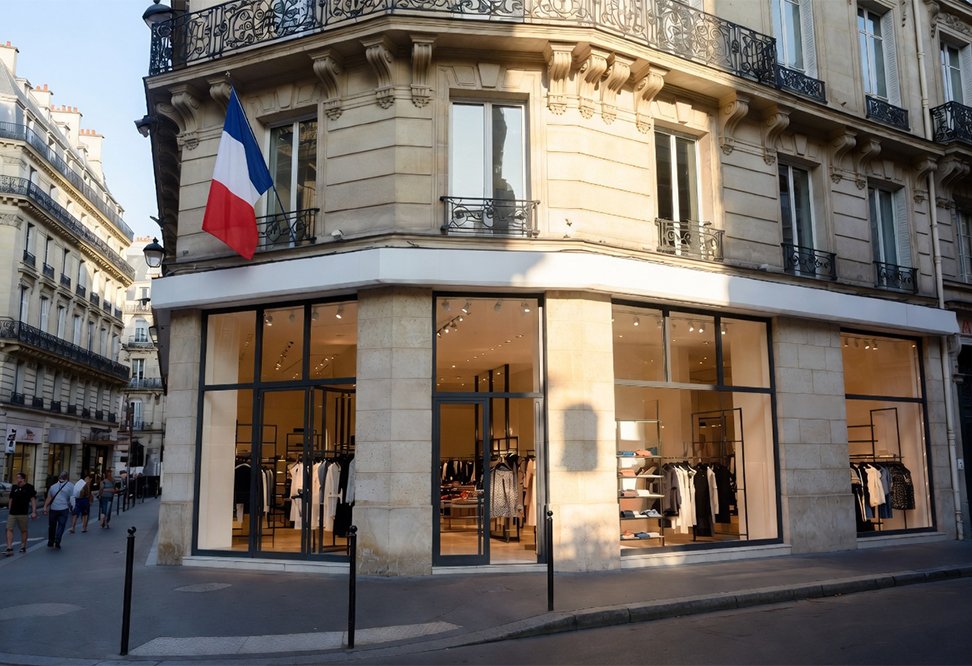
March confirmed that France’s fashion market remains under pressure, with online growth unable to offset falling physical-store sales and cautious household spending.
Textile and apparel sales in France fell 3.7% year on year in March 2026, including distance selling, according to aggregate data from the Institut Français de la Mode cited by FashionNetwork. The decline widened the sector’s gap with its pre-pandemic performance: March revenue was 13.4% below March 2019, showing that the French fashion market is still struggling to recover its former consumption base.
Calendar effect meets weak confidence
Part of the March decline reflected an unfavourable calendar, with four Saturdays in March 2026 compared with five in March 2025. But the weakness was not only technical. French consumers entered spring with tighter budgets, renewed inflation concerns and a more uncertain geopolitical backdrop, all of which weighed on discretionary fashion spending.
The pressure was visible across wider retail indicators. Procos reported that specialised clothing retailers’ store sales fell 4.4% year on year in March, while household confidence dropped to 89, below its long-term average of 100 and close to the threshold associated with unusually high pessimism.
Online gains cannot rescue stores
Channel performance showed a clear split. Distance selling increased 1.3%, while total e-commerce revenue rose 2.2%. Physical retail, however, remained the weak point, with in-store sales down 5.5% from a year earlier. Independent multibrand retailers suffered the steepest fall, with revenue down 6.6%.
This matters commercially because many traditional fashion chains still depend on store traffic to cover rent, staffing and inventory costs. Omnichannel investment may improve customer access, but it does not fully compensate for weaker footfall if physical stores continue to lose volume.
Q2 will test pricing power
For the first quarter of 2026, French textile-apparel revenue fell 1.9% year on year and remained 13.6% below Q1 2019. The market is therefore facing both a cyclical squeeze and a structural reset. Clothing and footwear inflation slowed sharply in March, but headline inflation accelerated, leaving consumers more selective about non-essential purchases.
The next signal to watch is spring-summer sell-through. If inflation pressure rises again or footfall fails to recover, retailers may be forced into heavier promotions, putting margins under further strain just as inventory decisions for the second half of the year become critical.
