

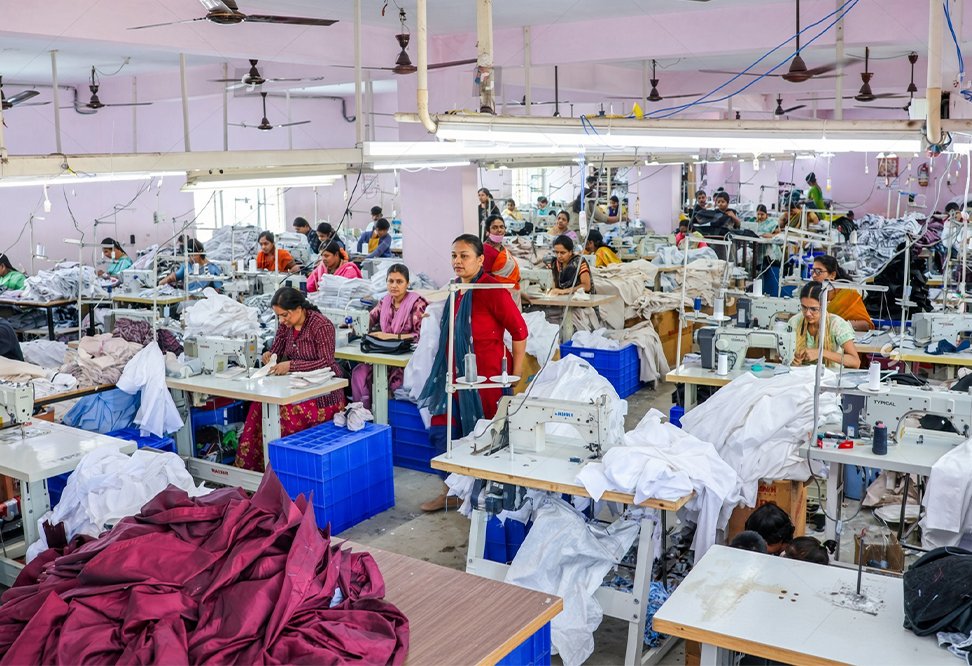
India is taking textile export policy deeper into individual manufacturing clusters, aiming to turn thousands of domestic producers and MSMEs into direct exporters over the next two to three years.
India’s Ministry of Textiles plans to develop 5,000–10,000 new textile exporters within two to three years, using district-level export roadmaps to expand the country’s participation in global markets. The initiative targets manufacturers that either do not export or export only intermittently.
The programme supports India’s larger ambition to raise textile and apparel exports from roughly $37 billion to $100 billion by 2030.
Export policy moves to the district
The strategy builds on the Ministry’s District-Led Textiles Transformation programme, launched in January. It identifies 100 Champion Districts with established textile ecosystems and 100 Aspirational Districts where manufacturing capability exists but export participation remains limited.
Government data show textiles, apparel and handicrafts were already exported from 548 Indian districts in 2025–26. Leading clusters included Tiruppur, Gautam Buddha Nagar, Bengaluru Urban, Gurugram, Panipat, Surat, Ahmedabad and Ludhiana.
Proposed interventions include exporter training, machinery upgrading, export facilitation centres, overseas market intelligence and stronger buyer linkages. Districts are also being encouraged to demonstrate sustainable production capabilities.
From $38 billion to $100 billion
India exported $37.8 billion of textiles, apparel and handicrafts in 2024–25, giving it about 4.1% of global textile and apparel trade, according to the Ministry. The US, EU and UK together represented 55% of exports.
The challenge is therefore considerable: reaching $100 billion would require India to more than double its export base within four years.
Competition broadens beyond large exporters
The strategy matters for competing manufacturing countries because India is not relying only on established exporters. It is attempting to enlarge the number, geography and product diversity of firms capable of selling internationally, while combining this with FTAs, MSME support, technical textiles, MMF products and higher-value manufacturing.
For Pakistan, Bangladesh and other South Asian exporters, the competitive signal is significant. India’s next export push will increasingly come from thousands of smaller manufacturers entering international markets alongside its large established groups.
The key measure of success will not be exporter registrations alone, but whether these new firms generate sustained export volumes, higher-value products and repeat international orders.
