

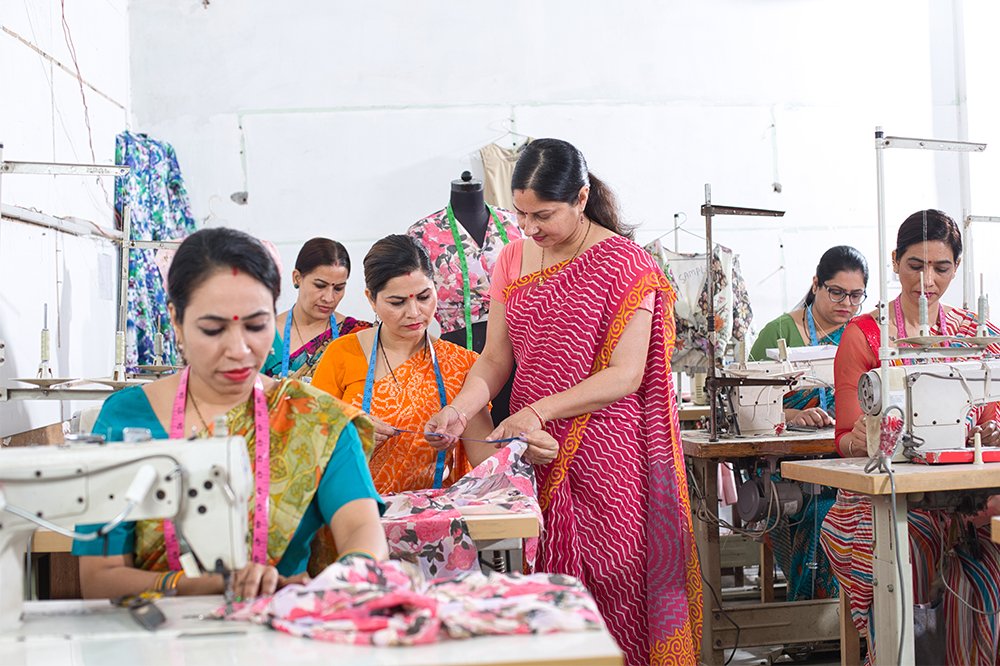
Annual growth of 2.1% offered a measure of resilience, but March’s weakness and the prolonged US tariff shock showed how exposed India’s textile trade remains to policy disruption and fragile demand.
India’s textile exports, including handicrafts, rose 2.1% in FY2025–26 to ₹3,16,334.9 crore, up from ₹3,09,859.3 crore a year earlier, according to the Ministry of Textiles. The result suggests the sector managed to preserve modest forward momentum despite a difficult global trade backdrop and unusually disruptive tariff action in its largest export market, the United States.
The composition of growth matters. Ready-made garments remained the largest contributor, rising 2.9% to ₹1.39 lakh crore, while man-made yarns, fabrics and made-ups grew 3.6% to ₹42,687.8 crore. Handicrafts, excluding handmade carpets, posted the strongest increase among major segments, up 6.1% to ₹15,855.1 crore. By contrast, the large cotton yarn, fabrics, made-ups and handloom segment was essentially flat, growing just 0.4% to ₹1.02 lakh crore.
Tariffs distorted the year
The annual gain came despite a prolonged tariff shock in the US market. On February 20, 2026, the US Supreme Court struck down Trump’s IEEPA-based global tariffs, but only after months of elevated duties had already disrupted trade flows. Reuters reported that, after the ruling, the Trump administration replaced the invalidated tariffs with a temporary 10% global tariff for 150 days, extending uncertainty even as the earlier regime was dismantled.
That uncertainty likely helps explain why the sector’s fiscal-year growth still looked uneven. The ministry said export growth was recorded in more than 120 destinations during April 2025 to February 2026, with stronger performances in markets including the UAE, UK, Germany, Spain and Japan. That points to useful geographic diversification, but also suggests India had to lean harder on non-US markets to offset pressure in its biggest destination.
Resilient, but not yet comfortable
The broader takeaway is that India’s textile sector has shown resilience, not strength. A 2.1% rise in such a difficult year is credible, especially with support from RoSCTL and RoDTEP extensions. But the result also shows how dependent the sector remains on policy stability, product upgrading and diversified market access.
The next test is whether India can turn this defensive performance into stronger export acceleration once tariff volatility eases. If not, FY2025–26 may look less like a recovery year and more like a year of successful damage control.
