

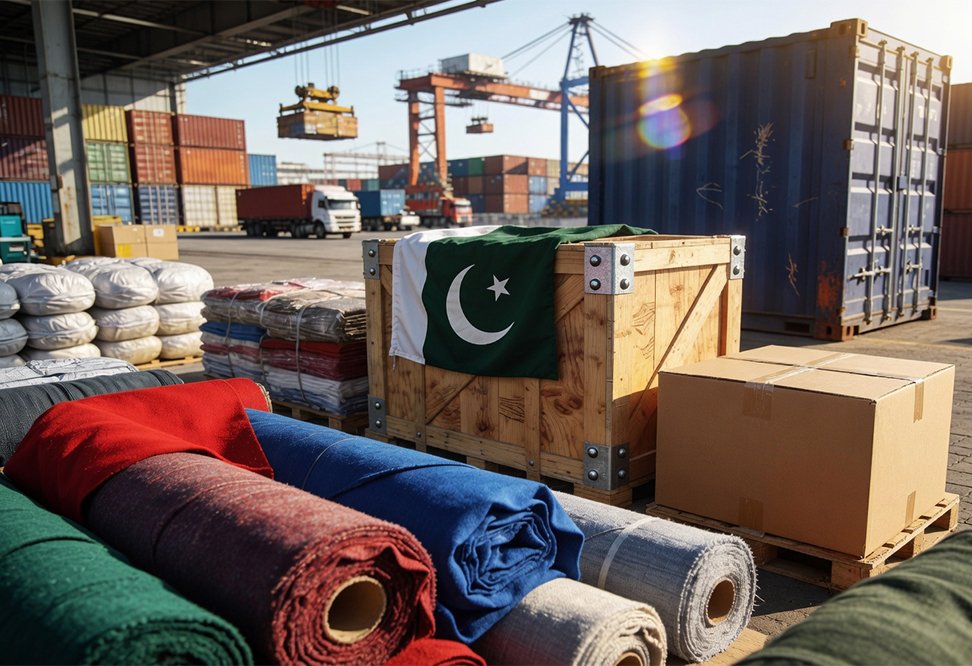
Marginal annual growth concealed weaker performance across knitwear, bedwear, towels and cotton fabrics, leaving Pakistan’s largest export industry dependent on garments and yarn for stability.
Pakistan’s textile and apparel exports increased only 0.26% to $17.93 billion in fiscal year 2025–26, from $17.88 billion a year earlier, according to provisional Pakistan Bureau of Statistics data.
The sector still generated almost 60% of Pakistan’s total merchandise exports, but the virtually flat result points to weak demand, pricing pressure and persistent competitiveness constraints. The year ended particularly poorly: textile exports fell 16.71% year on year in June 2026 to $1.27 billion.
Garments provide limited momentum
Readymade-garment exports rose 3.87% to $4.29 billion, making them one of the few major value-added categories to record growth. Cotton-yarn shipments increased 12.40% to $765 million, while exports classified as other textile materials advanced 8.67% to $790.9 million.
The yarn increase, however, is a mixed signal. It supports spinning-mill utilisation and foreign-exchange earnings, but exporting more intermediate material creates less domestic value than converting the same yarn into fabric, garments or made-up products.
Raw-cotton exports almost tripled to $2.6 million, although the small base makes the percentage increase commercially insignificant.
Core categories lose ground
Knitwear remained Pakistan’s largest textile export category at $4.97 billion but declined 0.88%. Bedwear was almost unchanged at $3.11 billion, while towel exports fell 1.93% to $1.06 billion.
Cotton-cloth shipments recorded the sharpest major decline, dropping 7.55% to $1.67 billion. Other made-up articles decreased 0.71%, while tents, canvas and tarpaulins fell 3.81%.
Trade imbalance widens
Pakistan’s total merchandise exports declined 5.93% to $30.14 billion during FY2025–26, while imports rose 8.14% to $69.76 billion. The resulting trade deficit widened to $39.62 billion.
The next test is whether exporters can reverse June’s contraction through improved energy-cost competitiveness, market diversification and higher-value product development. Without stronger growth in garments, technical textiles and finished home products, stable textile exports will be insufficient to offset Pakistan’s expanding import bill.
