

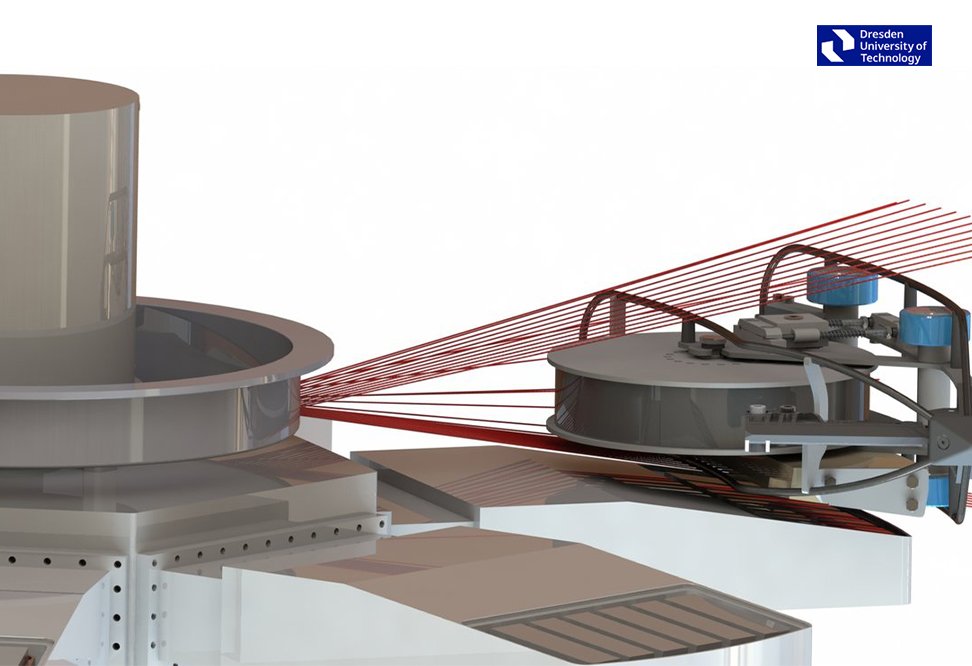
The German research project is using superconducting magnetic bearings to reduce yarn damage and open circular weaving to high-performance composite reinforcements.
Germany’s SupraWeave project is developing a contactless, levitating weft-insertion system designed to allow fragile carbon and glass fibres to be processed on circular weaving machines.
The project, led by TU Dresden’s Institute of Textile Machinery and High Performance Material Technology with Dresden-based evico GmbH, runs from January 2025 to December 2027. Its central objective is to overcome the high mechanical stresses that have limited the use of brittle high-performance fibres in conventional circular weaving.
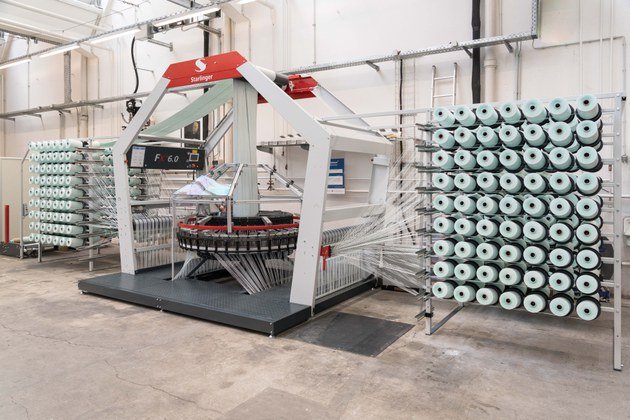
A shuttle without mechanical contact
SupraWeave replaces conventional shuttle guidance with superconducting magnetic bearings. The shuttle is magnetically stabilised and moves through the shed without physical contact, reducing friction and mechanical loading on both the shuttle and yarn.
The system is being combined with low-damage warp and weft guidance, modified fabric take-off, magnetic-bearing modelling and process-control algorithms. Initial trials on a weft feeder being developed for a Starlinger circular loom have produced promising results, according to project reporting.
Why composites matter
Circular weaving can produce seamless tubular textile structures that are particularly relevant to composite pipes, structural preforms and technical components. Carbon and glass reinforcements offer high strength-to-weight performance but can be damaged by impact and abrasion during weaving; previous research has shown conventional circular shuttle systems struggling to process these fibres reliably.
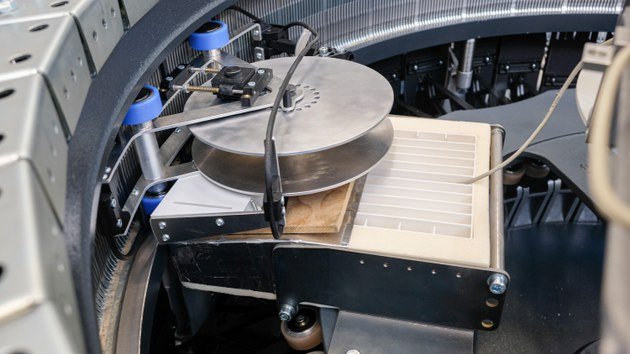
Potential end markets include aerospace, automotive and energy applications, where lightweight reinforced composites are increasingly important.
Machinery opportunity depends on industrial robustness
SupraWeave is significant because it applies superconducting levitation not to transportation, but directly to textile machinery. Evico already commercialises superconducting magnetic-bearing systems using electrically cooled cryostats, demonstrating that the underlying technology can be packaged for industrial environments.
The commercial test will be whether the system can deliver sufficient loom speed, reliability, cooling efficiency and maintenance simplicity at acceptable cost. If successful, it could expand circular weaving from conventional tubular fabrics into a higher-value manufacturing route for advanced composite reinforcements.
