

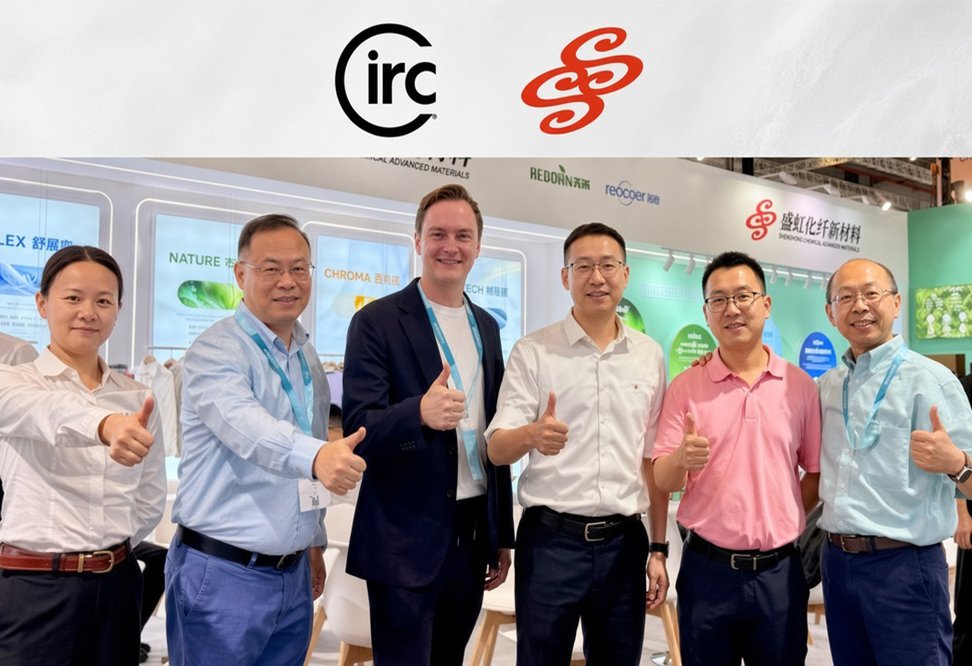
The agreement connects Circ’s recovered PET directly with one of China’s major fibre producers, moving circular polyester closer to commercial-scale filament yarn production.
US textile-recycling company Circ has partnered with Shenghong Chemical Fiber New Material Co. to commercialise polyester filament yarn made from textile-to-textile recycled feedstock, strengthening the industrial infrastructure needed to move circular polyester beyond pilot volumes.
Under the agreement, Shenghong will purchase Circ PET chips and convert them into recycled-content filament yarn at commercial scale. The arrangement gives Circ another route into established Asian textile supply chains while giving Shenghong access to polyester recovered directly from discarded textiles rather than bottles.
Closing the polycotton loop
Circ’s technology tackles one of textile recycling’s most difficult waste streams: blended polycotton fabrics. Its process separates and recovers the polyester and cellulose fractions so both can return to textile production.
For polyester, the recovered material can replace virgin fossil-based feedstock while remaining compatible with existing fibre-manufacturing infrastructure. Shenghong brings large-scale capabilities in direct-melt spinning, differentiated functional fibres and recycled polyester, with major production bases in Suzhou and Suqian.
Filament becomes the next test
The partnership is intended to validate Circ Polyester across commercial filament applications and establish a manufacturing model that can be replicated as volumes increase.
That is strategically important because recycling technology alone does not create a circular supply chain. Recovered polymers must also meet commercial requirements for spinnability, consistency, performance, price and volume before mills and brands can integrate them into mainstream collections.
Circ is pursuing this through a distributed manufacturing network. Its first industrial-scale recycling facility is under development in France, while partnerships with fibre and polymer producers are creating downstream routes for both polyester and regenerated cellulosic materials.
Scale shifts from technology to infrastructure
The Shenghong agreement shows textile-to-textile recycling entering a new phase: the bottleneck is increasingly industrial conversion capacity and market adoption, rather than proof of concept.
For polyester mills and apparel suppliers, the key signals now will be commercial yarn volumes, pricing against virgin and bottle-recycled polyester, and whether brands commit sufficient demand to support continuous large-scale production. Circ’s subsequent September agreement with Chinese staple-fibre producer BHF suggests that this downstream network is already broadening across both filament and staple applications.
