

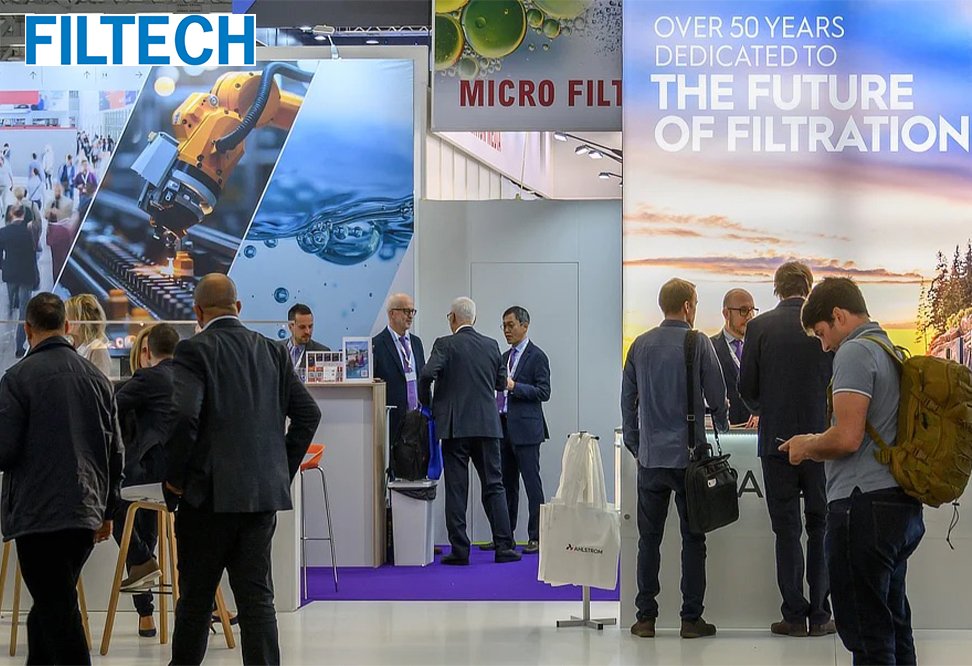
TMAS members Eton Systems and ACG Kinna Automatic will use FILTECH 2026 to show how automation can raise output, traceability and labour efficiency in technical textile filtration.
Swedish textile machinery suppliers will put automation at the centre of their FILTECH 2026 message, as filtration manufacturers face rising pressure to handle greater product variety, tighter quality control and persistent labour constraints. FILTECH 2026 will take place from June 30 to July 2 at KoelnMesse in Cologne, Germany.
Filtration’s production problem
Technical woven and nonwoven fabrics sit inside a wide range of filtration systems for air, gas and liquid applications, from industrial processes and transport to HVAC, appliances and institutional buildings. The operational challenge is not only volume, but also complexity: Interfil’s Skjåk plant in Norway produces about 230,000 air filter units a year across roughly 15,000 variants, with 9,000 products moving through production at any time and daily finished output of about 1,100 products.
A similar pressure is visible at Filtration System Products in Farmington, St. Louis, where daily production has reached more than 2,200 filter hoses and media. This level of variation makes manual handling a major constraint on throughput, consistency and shopfloor visibility.
Moving parts, not people
Eton Systems, a TMAS member, is addressing that bottleneck through individually addressable product carriers that move single units through each production step. At Interfil, Eton installed a 50-metre overhead UPS conveyor linking two production halls, reducing manual handling and truck transport between facilities. The system has improved efficiency, component traceability, quality control and site safety.
At FSP, the gains have been more directly measurable. Since installing an Eton system in 2023, the company says output has increased by 60% with the same operators and working hours. Its integrated quality system also ensures that only fully compliant products are unloaded.
The microfactory route
ACG Kinna Automatic, another TMAS member, will highlight a fully automated microfactory for finished filter bags. The system combines the KA-156 Automatic Filter Tube Line and KA-177 Automatic Filter Bag Production Line, handling fabric feeding, folding, seaming, cutting, reinforcement, bottom attachment and snap-ring attachment. Output is stated at 120 finished filter bags per hour, with alignment and quality control supported by high-definition vision cameras.
For filtration producers in Europe and the United States, the commercial test is clear: automation must justify itself through higher throughput, faster changeovers, fewer handling errors and better traceability across high-mix technical textile production.
