

The RWTH Aachen spin-off is pushing carbon-ceramic fiber technology toward aerospace, energy and high-performance composite applications.
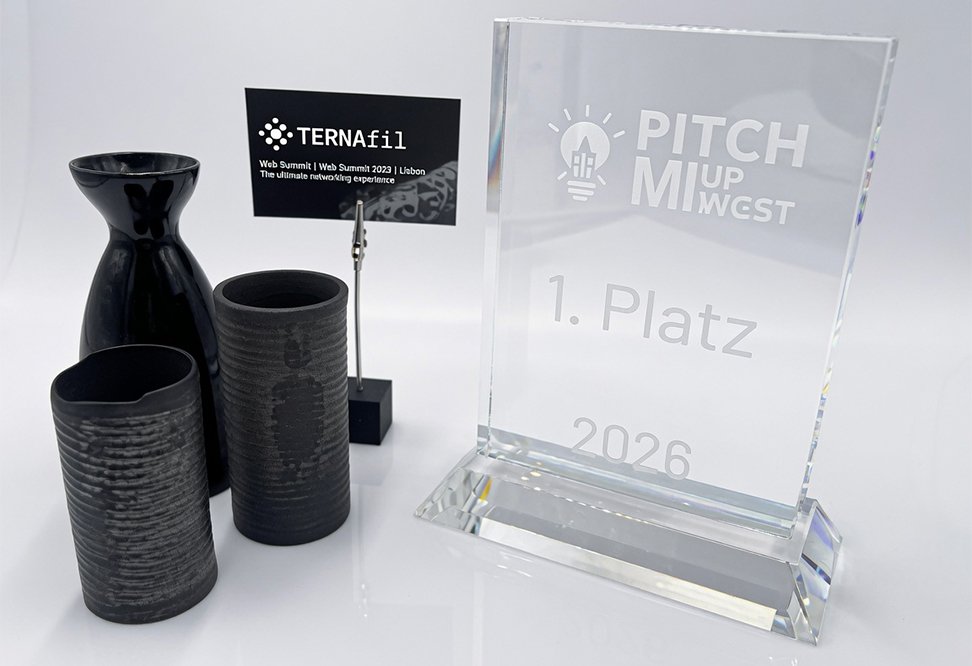
TERNAfil, a spin-off from RWTH Aachen University, has won first prize at PitchMiUp Night 2026 in Minden for MAXCarbon, a high-performance hybrid fiber that combines carbon’s mechanical strength with the temperature and corrosion resistance of ceramic materials. The award was presented on May 21, 2026, at the second PitchMiUp Night hosted by Bielefeld University of Applied Sciences.
Carbon meets ceramic
MAXCarbon is designed to address a long-standing materials trade-off. Conventional carbon fibers are strong, lightweight and conductive, but they oxidize or burn under extreme thermal conditions. Ceramic fibers offer heat and chemical resistance, but can be brittle, costly or harder to process. TERNAfil’s approach synthesizes a MAX-phase ceramic layer directly onto carbon fiber surfaces, allowing the fiber to remain lightweight and flexible while gaining chemical resistance, high-temperature stability and electrical conductivity.
According to TERNAfil, the process converts standard carbon fibers through a surface reaction at 1,250°C, forming a Ti₃SiC₂ MAX-phase hybrid in under 45 minutes. The company positions the technology as scalable and suitable for industrial adoption rather than laboratory demonstration alone.
Where the material could fit
The target markets are technically demanding rather than commodity textile segments. TERNAfil is developing the fiber for aerospace, energy technology and high-performance composites. Potential formats include chopped fibers and particles for coatings and polymer matrices; woven, braided and nonwoven technical textiles for electromagnetic shielding, thermal regulation and reinforcement; and ceramic or polymer matrix composites for structural, thermal-protection and load-bearing uses.
A research-to-industry signal
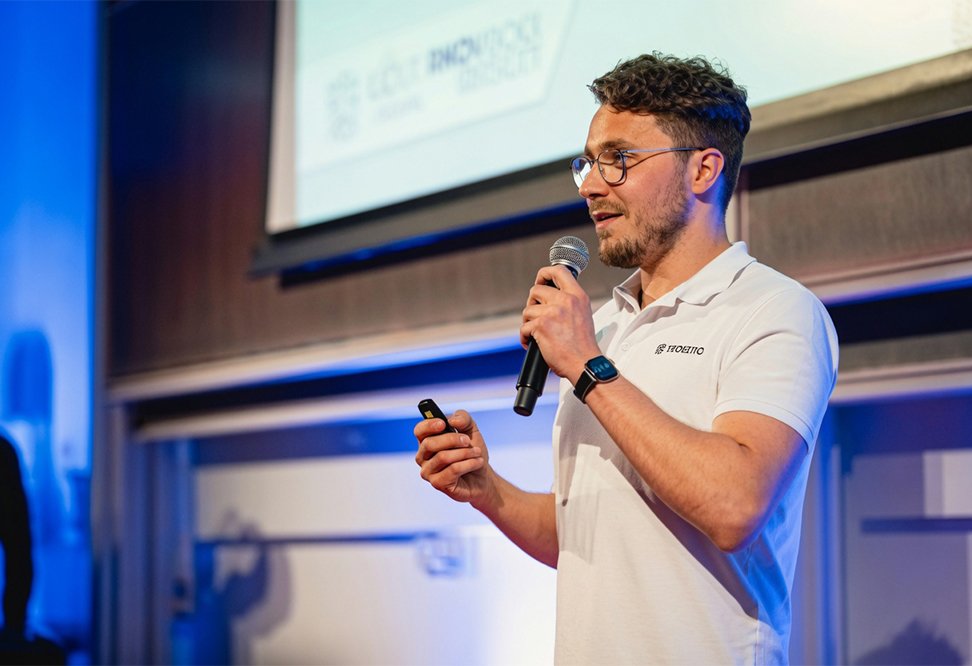
Fabian Jung, an ITA doctoral researcher and TERNAfil founder, said the award showed how current research can move from the laboratory into industrial applications. TERNAfil previously gained recognition in the AC² Start-Up Competition, underlining growing investor and industry interest in advanced fiber platforms with practical scale-up potential.
The next milestone will be technical validation at application scale: repeatable production, cost control, integration into textile and composite processes, and performance testing under real aerospace, energy and high-temperature industrial conditions.
