

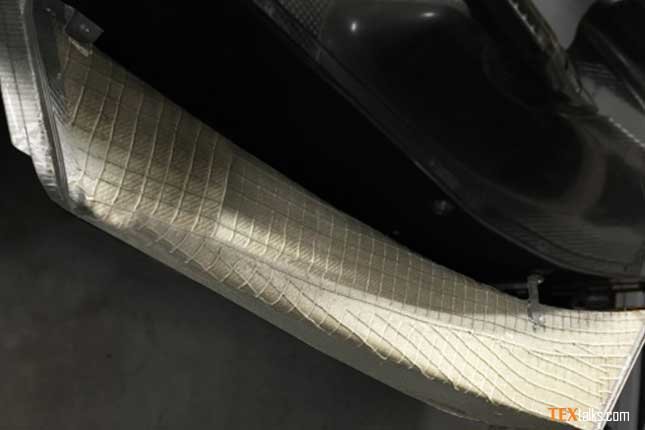
For the first time in motor racing, BMW has introduced a renewable fibre-based part in the making of its Formula E race car.
The conventional cooling shaft has been replaced with one made of flax in the BMW iFE.20, which recently won the ABB FIA Formula E Championship held in Saudi Arabia.
BMW Group Motorsport Director Jens Marquardt said, “The flax cooling shaft that we use in the BMW iFE.20 is further proof of the hugely important role of BMW iMotorsport as a tech lab for the BMW Group.
We are consistently using Formula E as an innovative platform for series development — in this instance for testing flax in extreme weather conditions. What’s particularly remarkable is the fact that in some areas this renewable material even has advantages over materials established in racing, such as carbon.
Our ambition is to always use the best suited material for each part.”
The cooling system for Formula E racers feeds the air that rushes into the car’s side pods to coolant-filled radiators connected via a system of pipework to the powertrain’s main heat producing components: motor, power electronics, and battery.
Compared with carbon, flax has greater absorption and greater impact resistance, which can be advantageous on the street circuits on which Formula E takes place with their bumps and crash barriers. The same is true of contact with other cars during races. Expansion of this concept to include other BMW Motorsport racing cars is already in the development phase.
The development of parts using generative design methods or 3D printing technology saved a considerable amount of weight compared with conventional development and production procedures, and gave engineers more room to manoeuvre in terms of the centre of gravity of the car and weight distribution.
