

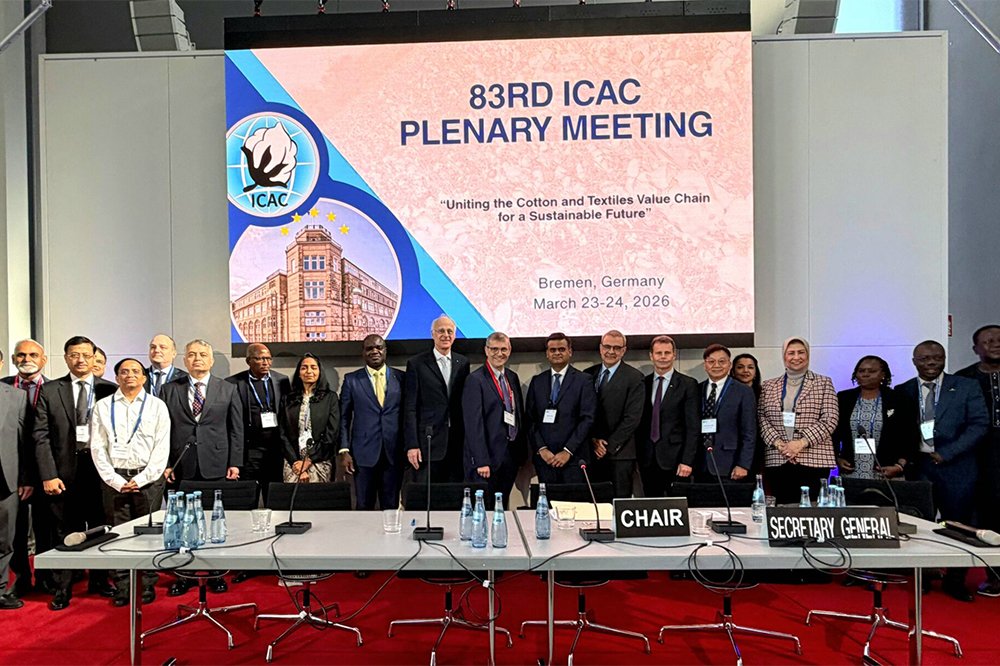

The Final Statement from the ICAC’s 83rd Plenary Meeting
Executive Director Eric Trachtenberg highlighted the ICAC’s strategic shift toward regenerative agriculture, investment promotion, proactive advocacy and innovation to support the global cotton economy. The report emphasized that while the industry faces pressures from climate change and synthetic fiber competition, cotton remains a vital catalyst to support rural economic transformation and global sustainability. Key priorities for the Secretariat include boosting yields through agricultural technology, making cotton a central part of the climate solution through carbon innovations, and ensuring the industry’s story is told accurately to global stakeholders.
Government Reports
Several member countries shared updates on production trends, policy developments, and sector challenges. Discussions highlighted the continued importance of smallholder farmer prosperity, the need for improved productivity and resilience, and the increasing pressure from rising input costs and climate variability. Delegates also emphasized the importance of strengthening domestic value addition and improving market access overseas to ensure sustainable sector growth.
Secretariat Reports
The Secretariat presented updates on its analytical work, technical activities, and strategic priorities. Key areas included improvements in data systems, ongoing research initiatives, and expanded engagement with stakeholders across the cotton and textiles ecosystem. The Secretariat also highlighted efforts to align its work with evolving global priorities, particularly sustainability, climate resilience, and value chain integration.
World Cotton Market Outlook: The Secretariat reported that world cotton production for the 2026/27 season is projected to decline by 4% to 24.9 million tonnes, primarily due to lower prices and weaker demand from major markets. While China and India continue to lead global production, significant reductions are expected in Brazil and Australia. Consumption is projected to remain stable at approximately 25 million tonnes, though planting intentions in the United States suggest a shift toward competing crops like corn and soybeans.
Communications and Outreach: The Secretariat outlined a robust strategy to combat misinformation and promote cotton’s benefits. Notable successes included direct engagement with the World Wildlife Fund, which led to the removal of inaccurate water-use statistics from their website. Ongoing initiatives include the #TruthTuesday campaign and the development of “The Book of Cotton,” a non-technical publication designed to explain cotton’s social and environmental value to a general audience. The Secretariat also announced a planned video project, “A World Without Cotton,” to illustrate the global consequences of losing the natural fiber industry.
Facilitating Investment in Emerging Markets: Discussions focused on the necessity of integrated textile manufacturing ecosystems. Highlights included India’s PM MITRA initiative and the potential for Africa to close policy gaps by linking cotton production directly to downstream garment manufacturing. Participants emphasized that while sustainability investments are essential, they require greater financial support from global brands and retailers to ensure profitability for smallholder farmers.
National Textiles Policies: This session examined how policy frameworks can drive innovation and competitiveness. Panelists addressed the evolving regulatory landscape, including EU restrictions on textile waste and the increasing importance of supply chain traceability. The session concluded that national policies must balance innovation with accessibility, which is particularly important for small and medium-sized enterprises (SMEs).
Technical Seminar: AI and Sensor Technologies: The 2026 Technical Seminar focused on “Deep Learning and Sensor Technologies for Automated Detection and Monitoring of Cotton Diseases and Insect Pests.” Experts presented advances in AI-enabled pest monitoring, such as the Cotton Microclimate and Insect Monitoring System (C-MIMS). The seminar highlighted a case study on jassid infestations in Egypt, illustrating how early detection through digital tools can prevent catastrophic crop loss. The session underscored the importance of integrating these high-tech solutions into existing Integrated Pest Management (IPM) frameworks.
Steering Committee Decisions
The Steering Committee addressed several administrative and strategic matters:
- Election of Officers: Mr. Shreyans Gupta (India) was elected as Chair of the Standing Committee for 2026/27, with Mr. Igor Moreira Moraes (Brazil) elected as Vice-Chair.
- 2027 Technical Seminar Topic: The Committee selected “Climate-resilient cotton varieties” as the core topic for the next technical seminar.
- Membership and Assessments: The Committee reviewed outstanding member assessments and emphasized that timely contributions are vital to maintaining ICAC’s financial stability and its ability to serve the global sector.
Across all sessions, several overarching themes emerged:
- Sustainability as a central priority
There is increasing alignment around the need for environmentally sustainable and socially responsible cotton production, including regenerative practices that can result in positive environmental impacts and advance the vision of cotton as a carbon negative fiber.
- Value chain integration
Strengthening linkages from production to final products remains critical to improving competitiveness, capturing greater economic value, and creating high-quality employment in the cotton and textile economy.
- Traceability and transparency
Growing regulatory and market demands are accelerating the adoption of traceability systems, certification schemes, and digital solutions.
- Climate resilience and innovation
Investment in research, technology, and climate-resilient production systems is essential to ensure the long-term viability of the sector.
- Global advocacy and demand creation
Delegates highlighted the need for coordinated efforts to promote cotton’s benefits to consumers, brands, policymakers, and the textile sector to address competition from synthetic fibers.
- Financial sustainability of ICAC
The organization is aggressively pursuing diversified funding models beyond reliance on country assessment payments to ensure continuity of its core functions and set the stage for expanded impact in the future.
