

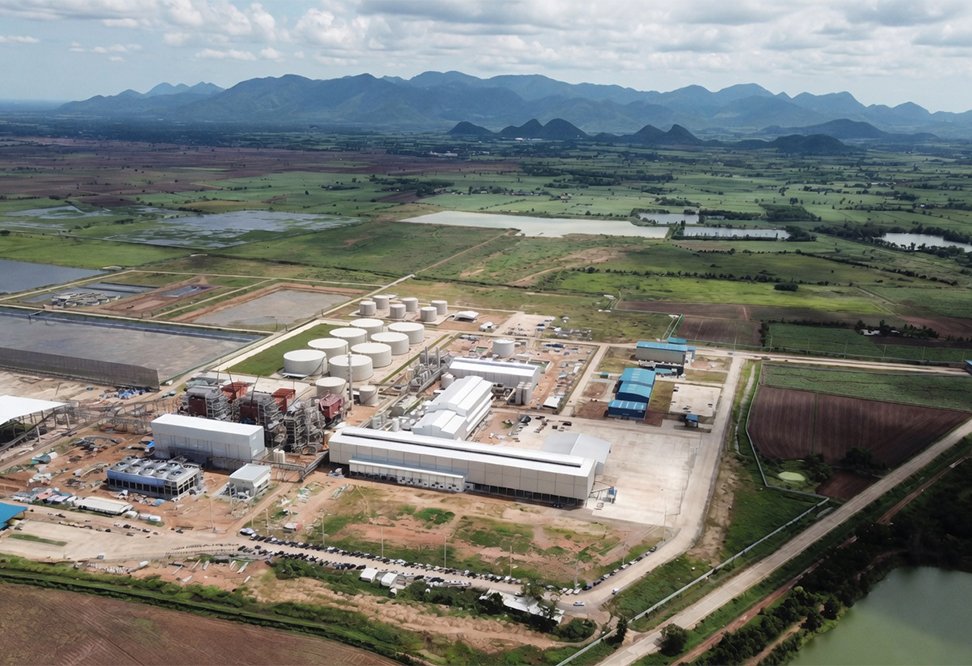
The 75,000-tonne Nakhon Sawan facility gives NatureWorks a second integrated production base and strengthens Asia’s role in renewable polymer supply chains.
NatureWorks has opened its new fully integrated Ingeo PLA biopolymer plant in Nakhon Sawan, Thailand, 24 years after starting full-scale production at its first manufacturing site in Blair, Nebraska. The Thailand facility makes NatureWorks the first PLA producer to operate a second production site, adding regional capacity for low-carbon materials used in packaging, fibres, nonwovens, food-service items, consumer goods and 3D printing.
A fully integrated PLA chain
The plant brings together lactic acid production from locally sourced sugarcane, lactide monomer production and polymer manufacturing in one complex. Located within the Nakhon Sawan BioComplex, the site is designed to improve supply-chain efficiency by placing renewable feedstock access, chemical conversion and polymer production close together. NatureWorks says the facility can produce the full portfolio of Ingeo grades.
Capacity for Asia-Pacific demand
The facility has annual capacity of about 75,000 metric tons of Ingeo biopolymer. That is strategically important as Asia-Pacific demand for biobased materials grows across flexible packaging, compostable food-service ware, nonwoven fibres and 3D-printing applications. For textile and nonwoven producers, the plant adds a nearer regional source of PLA-based fibres and polymers, reducing dependence on a single North American production base.
Low-carbon positioning
Ingeo produced at Nakhon Sawan is made from carbon derived from annually renewable resources. NatureWorks says the site is designed to support a carbon-neutral to net-negative polymer-level profile, based on life-cycle assessment data. This claim will matter most to brands and converters that must document material-level carbon reductions, renewable content and end-of-life pathways for packaging and textile applications.
The opening also deepens Thailand’s position in bioplastics manufacturing by linking polymer production with local sugarcane agriculture and skilled industrial employment. The next test will be commercial adoption: whether expanded PLA supply can convert sustainability interest into larger-volume substitution in packaging, fibres and consumer applications while meeting performance, cost, compostability and traceability requirements at scale.
