

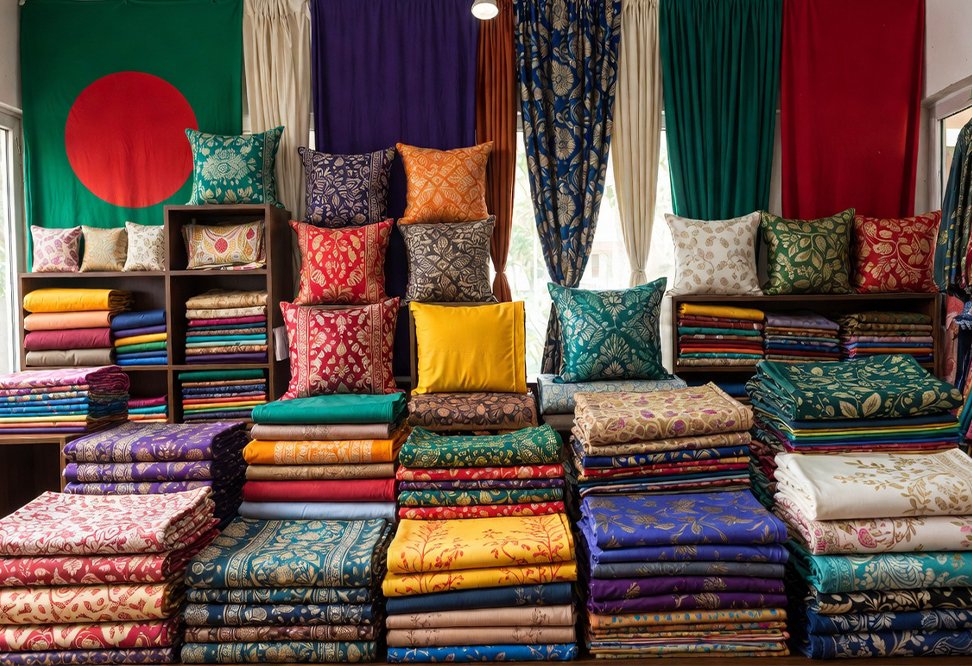
The sector’s modest ten-month growth masks a sharper monthly recovery, strengthening its role as a stabilising export category beyond core apparel.
Bangladesh’s home textile exports are showing signs of renewed momentum, offering a useful point of resilience in an export basket still heavily dependent on ready-made garments. In the first ten months of FY2025–26, home textile exports rose 3.46% year on year to $766.08 million, according to Export Promotion Bureau data cited by The Daily Star. The figure matters because overall merchandise exports during July–April fell 2.02% to $39.39 billion, despite a strong April rebound.
April points to stronger buyer activity
The latest monthly data suggests an improvement in buyer demand. Bangladesh’s total merchandise exports rose 32.92% year on year to $4 billion in April, ending an eight-month decline, while apparel shipments reached $3.14 billion during the month. The EPB also reported positive growth across Bangladesh’s top 20 export destinations, with the US up 43.01% and the UK up 23.46%.
Home textiles benefited from the same recovery pattern. Unlike fast-fashion categories, the segment is anchored in replenishment-driven products such as bed linen, towels, curtains and home furnishing items. These categories are less exposed to short fashion cycles and more dependent on quality, compliance, finishing, delivery reliability and design depth.
A diversification opportunity
For Bangladesh, the strategic value of home textiles lies in export diversification. Garments still account for more than 80% of national export earnings, and RMG exports declined 2.82% year on year during July–April to $31.71 billion. A positive home-textile performance therefore provides balance at a time when knitwear and woven garments remain vulnerable to buyer caution, energy-cost volatility and geopolitical disruption.
Large integrated players such as Zaber & Zubair Fabrics, Ha-Meem Group and Saad Musa Group give the segment a stronger industrial base, particularly in bed linen, fabric manufacturing and diversified textile products. Their participation in international sourcing platforms also helps improve Bangladesh’s visibility among global home-textile buyers.
The next phase will depend on whether exporters can move beyond volume supply into higher-margin design, branded collections, sustainable materials, advanced finishing and faster product development. If that happens, home textiles can become more than a supplementary export line; they can become a steady, scalable growth pillar.
