

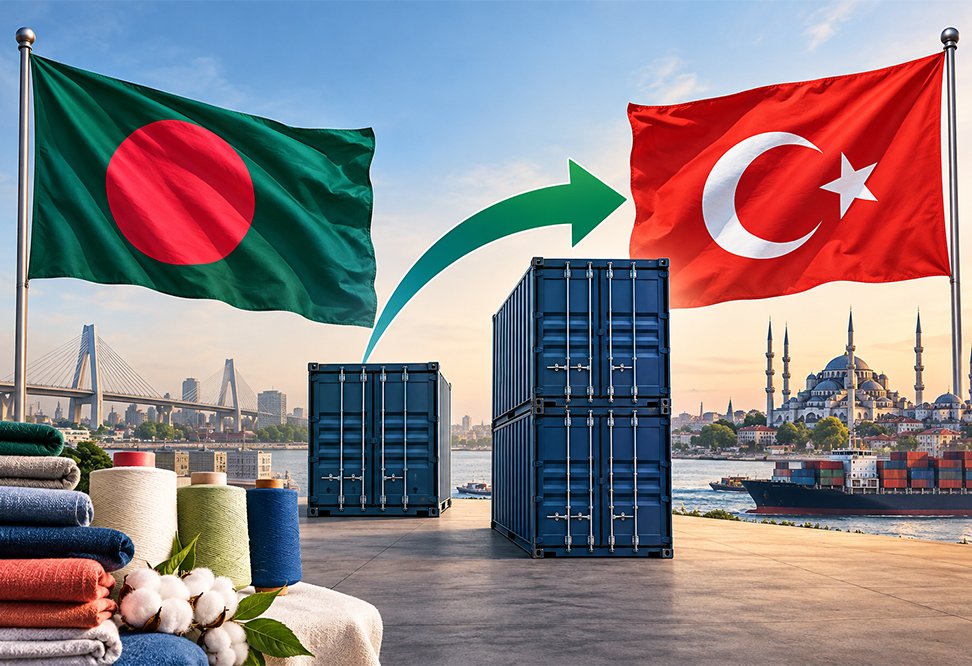
Rapid growth strengthens Türkiye’s position as an emerging destination, while officials urge exporters to broaden products and sustain quality and delivery.
Bangladesh’s merchandise exports to Türkiye reached $210.54 million during July–September 2026, increasing 100.11% from $105.21 million a year earlier, according to Export Promotion Bureau figures reported by BSS. The increase added approximately $105.33 million in export earnings during the first quarter of FY2026–27.
Apparel leads the market opportunity
Bangladesh mainly exports apparel to Türkiye, alongside jute and jute products, footwear and certain equipment categories. However, the BSS report does not provide a product-level breakdown of the quarterly increase, so the doubling cannot be attributed entirely to garments.
BKMEA Executive President Fazle Shamim Ehsan said changing employment preferences in Türkiye were creating opportunities for imported garments. He identified Bangladesh’s production capacity, competitive pricing, quality and timely delivery as strengths, while encouraging expansion into higher-value garments, man-made fibres and technical textiles. His explanation represents an industry assessment rather than a quantified analysis of Turkish production.
Growth outpaces the national export increase
Türkiye’s performance substantially exceeded Bangladesh’s overall merchandise export growth of 6.34%. National exports reached $13.094 billion in the quarter, placing Türkiye’s share at approximately 1.61%, calculated from EPB figures. The market is therefore expanding rapidly from a comparatively small base.
Bangladesh’s garment exports increased 6.10% to $10.579 billion over the same period. Knitwear earnings rose 6.88% to $5.964 billion, while woven garments grew 5.11% to $4.615 billion. The United States remained the largest destination, taking $2.592 billion of merchandise exports, followed by the United Kingdom and Germany.
Diversification requires product-specific preparation
EPB Vice Chairman Muhammad Hasan Arif called for closer assessment of buyer demand and product-level opportunities. He highlighted diversified jute products and footwear, while stressing technical standards, certification and manufacturing capability for equipment exports. Trade fairs and buyer-seller meetings were identified as routes to stronger commercial links.
Looking ahead, sustained growth will depend on repeat orders and a broader product mix. Competitive prices, consistent quality and reliable delivery remain the requirements officials identified for consolidating Bangladesh’s position in Türkiye.
