

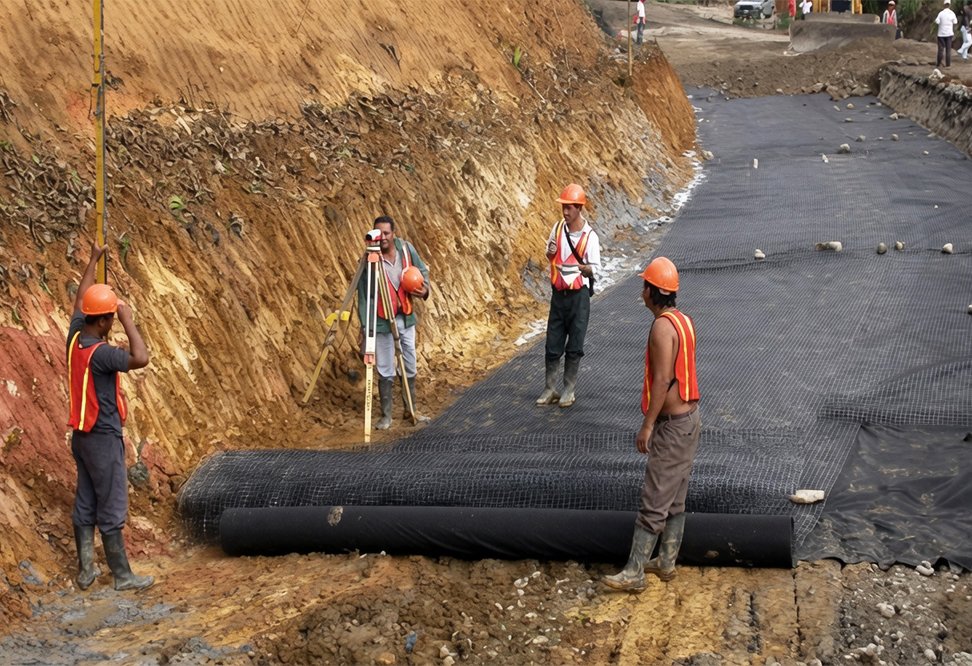
For technical-textile producers, geosynthetics offer a durable growth category tied to roads, railways, landfills, water systems and climate-resilient construction.
The global geosynthetics market is expanding steadily as governments and private developers seek cheaper, faster and more durable civil-engineering solutions. Public market estimates vary: MarketsandMarkets projects growth from $12.44 billion in 2025 to $16.73 billion by 2030, a 6.1% CAGR, while Precedence Research puts the market at $17.93 billion in 2025 and forecasts $39.53 billion by 2035, an 8.23% CAGR.
The wide range reflects differences in market scope, but the direction is consistent. Geosynthetics are becoming embedded in modern infrastructure, environmental protection and soil-engineering systems.
From technical fabric to civil-engineering material
Geosynthetics include geotextiles, geomembranes, geogrids, geonets, geofoams, geosynthetic clay liners and geocomposites. Their core functions are separation, filtration, drainage, reinforcement, containment and erosion control.
In transportation, the US Federal Highway Administration identifies common uses in paved and unpaved roadways, embankment reinforcement, water-flow barriers, liners, cutoffs and drainage improvement. Geotextiles and geogrids are among the most common materials in transportation applications.
Waste and water drive adoption
Waste management remains one of the strongest application areas. Landfills use geomembranes, geosynthetic clay liners and geotextiles for lining, leachate collection and capping systems to reduce soil and groundwater contamination risk.
Water management is another major growth driver, especially in reservoirs, canals, ponds, mining containment, irrigation systems and flood-control projects. In weak-soil regions and fast-urbanising economies, geosynthetics can reduce aggregate use, improve pavement life and shorten construction time.
Asia remains central
Asia-Pacific is central to the opportunity. Precedence Research estimates the region held 42.91% of the market in 2025, supported by infrastructure development, urbanisation, roads, railways, mining and environmental-protection projects.
For textile manufacturers, the opportunity is not commodity fabric alone. Growth will favour suppliers with polymer knowledge, nonwoven capability, coating and lamination expertise, tensile testing, puncture-resistance testing and project-specific certification.
The next phase of competition will be shaped by performance data, durability, recycled-polymer content and the ability to meet civil-engineering specifications. Geosynthetics are no longer peripheral technical textiles; they are becoming infrastructure materials.
