

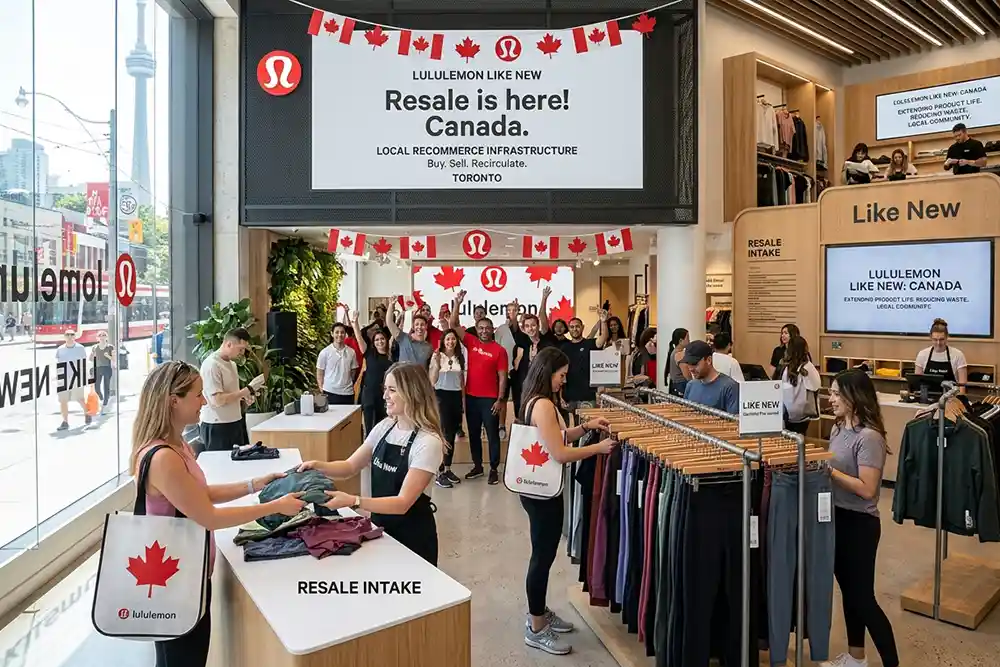
The expansion pairs branded second-hand sales with Canadian cleaning, grading and fulfilment, showing how circular retail increasingly depends on specialised reverse-logistics infrastructure.
Lululemon has expanded its Like New resale programme to Canada, its home market and the first national expansion beyond the United States. The move is supported by Tersus Solutions’ new Calgary facility, which will handle cleaning, conditioning, grading and fulfilment of pre-owned lululemon products.
Calgary shortens the reverse supply chain
Tersus’ 25,817-square-foot Calgary operation is its fifth North American facility and first company-owned site outside the US. It currently employs 22 people and is designed to reduce cross-border shipping, duties and processing times for Canadian resale inventory.
The company uses recycled liquid CO₂ for much of its garment cleaning instead of conventional water-based laundering. Tersus says its operations saved 2.6 million gallons of water during 2025, although comparable independently verified lifecycle data for the new Canadian operation has not been published.
Resale model evolves
Lululemon began piloting Like New in 2021 and expanded it across the US in April 2022. The programme has since returned more than 2 million traded-in products to circulation.
The Canadian consumer model is still developing. Lululemon’s current Like New FAQ states that conventional in-store trade-in is not yet available in Canada, while its resale platform allows sellers to list eligible products and receive either 70% of the sale price in cash value or 90% as a lululemon e-gift card.
That distinction qualifies reports describing the Canadian launch simply as an extension of the US trade-in programme.
Circularity becomes an operating capability
For apparel brands, the larger lesson is that resale requires more than an online storefront. Authentication, cleaning, grading, repair, pricing, inventory management and fulfilment create a second supply chain running in reverse.
Lululemon’s next test will be whether Canadian resale generates sufficient inventory turnover and customer participation to become a meaningful commercial channel rather than primarily a sustainability initiative. Local processing could improve those economics by reducing logistics friction while keeping high-value garments in circulation longer.
