

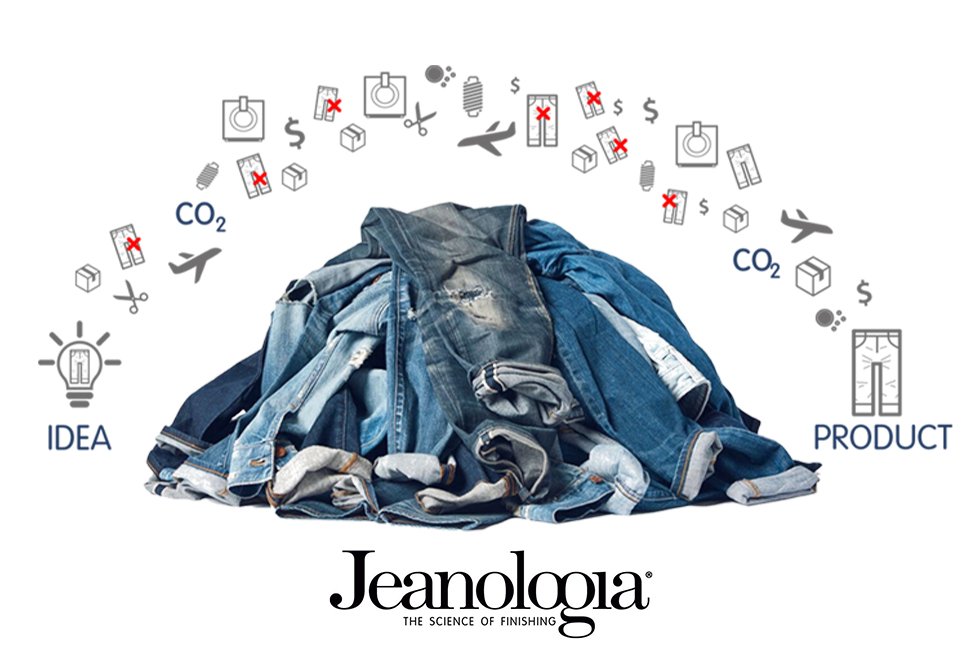
The next stage of sustainable denim will require mills, fibre recyclers, laundries, brands and data platforms to work from the same product-design and impact-measurement logic.
Jeanologia is positioning industry collaboration as the practical route to circular denim, arguing that fashion’s largest environmental challenges cannot be solved by one organisation alone. Carmen Silla, the company’s marketing director, told Sourcing Journal that circularity requires cooperation across the value chain, not isolated innovation by technology suppliers or brands.
That view reflects a broader shift in denim. Water-saving finishing, laser design and ozone systems are no longer enough on their own. Circular products also need recyclable material choices, lower-impact processing, credible data, traceability and commercial designs that buyers and consumers will accept.
Measurement before marketing
Jeanologia’s Environmental Impact Measuring software, or EIM, is central to its approach. The tool assesses garment-finishing processes across water consumption, energy consumption, chemical use and worker-health impact. It is designed to provide a standard measure of finishing impact regardless of production location, machinery or technology used.
The company says EIM is open for use on all finishing equipment, including machinery made by competitors. That matters because denim circularity cannot scale if each supplier uses separate impact language. Comparable metrics allow brands, laundries and mills to identify high-impact processes, compare alternatives and track improvement.
Circular denim needs system design
A useful example is REICONICS, the collaborative capsule developed by Recover, Evlox and Jeanologia. The 14-style collection used up to 32% GRS-certified Recover recycled cotton fibre from post-industrial textile waste, with Evlox developing the fabrics and Jeanologia applying finishing technologies. The partners also used an all-cellulosic, mono-material approach, including sewing threads, to improve recyclability.
The finishing package combined laser, G2 ozone, eFlow and ATMOS processes, with claimed finishing-stage water savings of up to 80% and Low Impact EIM scores across the garments.
Scale is the next test
Jeanologia has a sizable installed base, reporting presence in 78 countries, more than 5,400 machines worldwide and 1,097 clients in its 2024 sustainability report. The commercial question is whether this network can help move circular denim from limited capsules to repeatable sourcing programmes.
The next bottleneck will be less about invention and more about alignment: recycled-fibre availability, mono-material design discipline, mill capability, finishing data, buyer specifications and end-of-life systems must all connect. Without that, circularity remains a showcase. With it, denim can become one of fashion’s most practical circularity test beds.
