

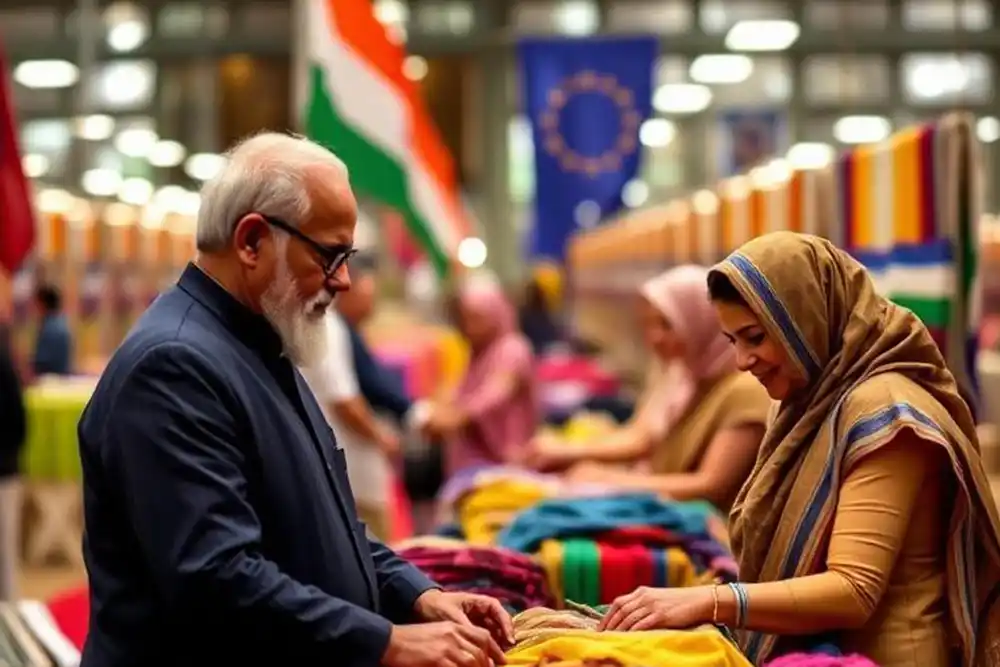
India’s newly signed India–EU Free Trade Agreement (FTA) is expected to be a structural game-changer for the textile and apparel sector, with projections of nearly 7 million new jobs and a dramatic expansion of India’s presence in the European market.
Following the signing on January 27, India’s Commerce Minister Piyush Goyal said the agreement will grant Indian exporters preferential, near zero-duty access to the European Union’s textile and apparel market—valued at approximately $250 billion.
From marginal player to major supplier
- Current India–EU textile and apparel exports: ~$7 billion
- Post-FTA export potential: up to $40 billion
- Current tariff disadvantage faced by India: up to 12%
- Key beneficiaries losing tariff edge: Bangladesh, Turkey, Vietnam, China
Until now, Bangladesh has dominated EU sourcing with roughly $30 billion in annual exports, aided by zero-duty access as a Least Developed Country (LDC). The FTA effectively levels the playing field for India as Bangladesh prepares to graduate from LDC status.
Employment impact at a national scale
Textiles are India’s second-largest employer after agriculture, supporting around 40 million jobs across spinning, weaving, processing, and garmenting. The expected export surge is likely to:
- Drive large-scale hiring, especially in labour-intensive segments
- Benefit rural employment and women workers
- Stabilise an industry under prolonged margin and demand pressure
Industry bodies have welcomed the agreement as historic. The Southern India Mills’ Association called the FTA a turning point that could permanently alter the growth trajectory of Indian textiles and apparel.
Southern India in the spotlight
Southern India—particularly Tamil Nadu—is expected to see outsized gains:
- Accounts for ~29% of India’s textile exports to the EU
- Current exports: ~$2.3 billion
- Major clusters set to benefit: Tiruppur (knitwear) and Karur (home textiles)
These clusters are already export-oriented and well-positioned to scale quickly once duty barriers fall.
Technology, machinery, and long-term competitiveness
Beyond exports, the FTA is expected to:
- Improve access to advanced EU textile machinery
- Support technology upgrades in weaving, processing, and technical textiles
- Reduce friction in importing $2.6–3 billion worth of machinery annually from Europe
Combined with domestic reforms—such as rationalisation of man-made fibre duties, export incentives, and interest subvention—the FTA strengthens India’s case as a reliable, large-scale alternative sourcing hub.
Strategic significance
Industry leaders stress that the speed of implementation will be decisive. Early operationalisation is seen as critical to:
- Reviving investment
- Restoring capacity utilisation
- Achieving India’s long-term goals of $250bn industry size and $100bn exports by 2030
In effect, the India–EU FTA does not merely boost exports—it repositions India within global textile value chains, shifting it from a tariff-constrained supplier to a strategic manufacturing and employment powerhouse in one of the world’s most regulated and valuable apparel markets.

